We stand at a fascinating precipice in software engineering. For the last two years, we’ve been treating Large Language Models (LLMs) like incredibly smart, albeit single-threaded, scripts. You prompt a model, it processes, and it responds. It’s functional, but it’s fundamentally limited. It’s the equivalent of running MS-DOS in a world that demands the multitasking capabilities of macOS or Linux.
The industry is pivoting. A 2024 paper from Stanford’s Human-Centered AI (HAI) institute identifies the move from monolithic models to “Compound AI Systems”—architectures where multiple models and tools collaborate to solve complex tasks. To manage this collaboration, we don’t just need better models; we need an operating system.
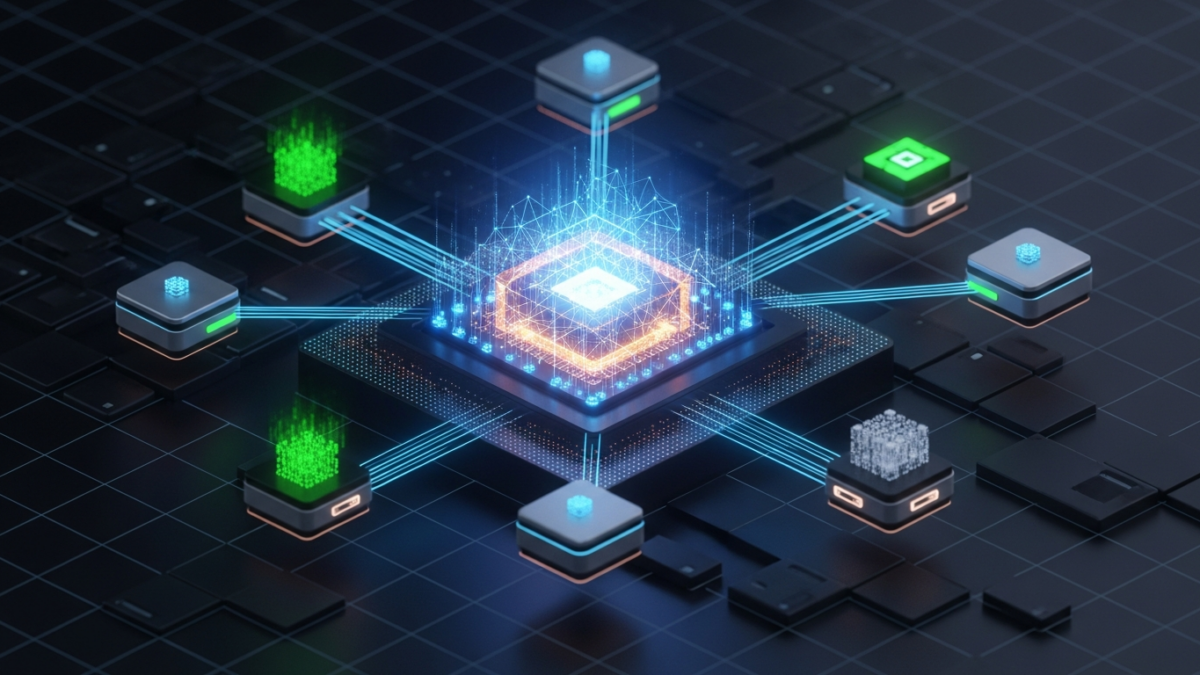
Welcome to SwarmOS. This isn’t a traditional OS managing hardware threads and file descriptors. It is a distributed orchestration kernel designed to schedule, communicate, and secure fleets of autonomous AI agents. Let’s dissect the architecture of the first OS built for the agentic web.
The Kernel Concept – Why Agents Need an OS
If you’ve ever tried to chain five different LLM calls together in a Python script, you know the pain. You manage the state, you handle the API errors, and you pray the context window doesn’t overflow. That is not scalable architecture.
SwarmOS acts as an Orchestration Kernel. In a standard OS, the kernel manages CPU scheduling and memory allocation. In SwarmOS, the kernel manages agent scheduling and token budgeting.
When we talk about monolithic models, we hit the bottleneck of serial processing and limited context. A single model trying to act as a travel agent, a financial advisor, and a coder simultaneously will eventually hallucinate or lose track. SwarmOS solves this by breaking the monolith into specialized micro-agents. The kernel ensures that the “Research Agent” hands off its findings to the “Writer Agent” without dropping the data payload. It abstracts away the complexity of the swarm, presenting the developer with a unified interface rather than a tangled mess of API keys and WebSocket connections.
Agent Handoff Protocols & IPC
The core innovation of frameworks like OpenAI’s October 2024 release of Swarm is the concept of the “handoff.” In traditional distributed systems, we talk about Inter-Process Communication (IPC). In SwarmOS, we talk about Agent Handoffs.
Imagine a customer support scenario. A user starts by asking about pricing. The SalesAgent handles the conversation. Suddenly, the user asks a highly technical question about API integration. The SalesAgent recognizes it is out of its depth. In a standard script, you’d need complex logic to switch prompts. In SwarmOS, the agent initiates a handoff.
This isn’t just forwarding a text message. It involves transferring the full conversational context and the variable state to the new agent. The TechSupportAgent wakes up already knowing who the user is and what they were just discussing.
Technically, this requires a “Context Bus.” This is a high-throughput data pipeline (often utilizing JSON over WebSockets) that functions like the system bus in your computer. Here is a simplified Python representation of how a Handoff function might look within a SwarmOS architecture:
class Agent:
    def __init__(self, name, role, instructions):
        self.name = name
        self.role = role
        self.instructions = instructions
        self.context_store = {}

    def execute(self, user_input):
        # Processing logic here
        response = self.process_logic(user_input)
        return response

    def handoff(self, target_agent):
        """Transfers context and control to another agent."""
        print(f"[SwarmOS] Handing off from {self.name} to {target_agent.name}")
        target_agent.context_store = self.context_store.copy()
        return target_agent

# Example Usage
sales_bot = Agent("Sales_01", "Sales", "You sell software.")
tech_bot = Agent("Support_01", "Support", "You fix bugs.")

# Trigger handoff based on intent
active_agent = sales_bot.handoff(tech_bot)
Beyond handoffs, SwarmOS handles Function Calling registry. The OS maintains a manifest of available tools (API endpoints, database queries) and makes them discoverable to agents. When an agent needs data, it queries the kernel, not the raw internet, ensuring security and standardization.
Distributed Scheduling and Resource Allocation
One of the biggest hurdles in multi-agent systems is “latency stacking.” If you have a linear workflow where Agent A processes, then passes to B, then C, you are adding network latency at every step. If each step takes 1 second, a 5-step workflow takes 5 seconds. For a real-time application, that is unacceptable.
SwarmOS must embrace an Event-Driven Architecture. Instead of the old “ReAct” (Reason + Act) loop, which is serial and blocking, SwarmOS uses a non-blocking I/O model.
Consider a financial trading swarm. A MarketDataAgent pushes a price update event. This event should instantly trigger both a RiskAgent (to assess exposure) and a TradeAgent (to execute the order). These two agents run in parallel. SwarmOS manages the concurrency, ensuring that token limits across various API providers are not breached and that rate limits are respected.
On the infrastructure layer, we view agents as ephemeral pods. By integrating with Kubernetes, SwarmOS can scale the swarm horizontally based on task queue depth. If the inbox is flooded, the OS spins up five more instances of the TriageAgent. When the queue clears, it scales down to save compute costs.
Memory Hierarchies – From Cache to Vector Store
An OS without a memory management system is useless. For AI agents, memory is not just RAM; it is the distinction between a one-shot interaction and a long-term relationship.
We must architect a three-tiered memory stack:
1. L1 (Ephemeral Context): This is the immediate conversation history. It is volatile and expensive (measured in tokens). It is equivalent to CPU cache.
2. L2 (Short-term State): A fast, key-value store like Redis. This holds session variables, user preferences, or the current state of a shopping cart. It persists across the session but is cleared when the interaction terminates.
3. L3 (Long-term Knowledge): Vector databases (Pinecone, Milvus) or data lakes. This is where the agent “remembers” that the user prefers aisle seats or that they had a support ticket six months ago.
The critical challenge here is Garbage Collection. Unlike a standard OS that allocates and frees memory blocks, an AI agent suffers from “context pollution.” If an agent remembers too much irrelevant detail, its performance degrades. SwarmOS needs intelligent garbage collection policies to archive or prune old memories based on relevance scores and time decay.
Security, Sandboxing, and the “Root” Problem
Giving agents the ability to execute code is powerful, but it is terrifying. If an agent decides to run a rm -rf / command, or sends a database password to a user, the results are catastrophic.
SwarmOS must implement strict Sandboxing. Agents running Python or JavaScript should do so inside containerized environments, such as Docker or WebAssembly (WASM) micro-runtimes. These containers are ephemeral and isolated from the host system.
Furthermore, we need Role-Based Access Control (RBAC) for agents. An AccountantAgent should strictly have read-only access to the general ledger and no access to the MarketingAgent‘s email tools. The OS layer sits between the agent and the resource, validating every function call against a permissions matrix.
Finally, we must address Jailbreak Resistance. The OS must act as a gatekeeper, validating outputs before they are executed. If the kernel detects a prompt injection attack attempting to override system instructions, it can terminate the agent process immediately.
Key Takeaways
- Abstraction is Key: SwarmOS provides the necessary abstraction layer to manage complex “Compound AI Systems” without drowning developers in plumbing code.
- Handoffs over Chaining: Utilizing stateful handoffs (context transfer) allows for modular specialization, where distinct agents handle specific domains.
- Parallel Execution: Moving from serial ReAct loops to event-driven, parallel processing is essential to mitigate latency stacking.
- Security by Design: Treating agents as untrusted users requiring sandboxing and strict RBAC is non-negotiable for enterprise deployment.
The future of AI isn’t a bigger model; it’s a smarter system. By architecting SwarmOS, we move from the era of the “smart script” to the era of the autonomous digital workforce.
Get the next deep dive before it hits search.
RodyTech publishes practical writing on AI systems, infrastructure, and software that teams can actually ship. Subscribe for new posts without waiting for an algorithm to surface them.
- One useful email when a new article is worth your time
- Hands-on notes from real builds, deployments, and ops work
- No generic growth funnel copy, just the writing
No comments yet