
The Bottleneck of Cloud-Only AI
The current architectural landscape for Large Language Models (LLMs) is heavily centralized. Organizations are funneling every prompt—whether it’s generating code, summarizing documents, or powering chatbots—through massive API endpoints controlled by OpenAI, Anthropic, or Azure. While this offers convenience, it introduces significant friction: unpredictable API costs, strict data privacy concerns, and unavoidable network latency.
For many applications, sending data to a distant data center is a non-starter. Imagine an industrial IoT system that needs to detect anomalies in real-time or a privacy-focused healthcare app analyzing patient data locally. The round-trip time to the cloud and back (often hundreds of milliseconds) kills the user experience for real-time interaction.
This is where the “Serverless Edge” paradigm enters the chat. By moving compute closer to the user—into CDNs, on-premise hardware, or even the browser itself—we can drastically reduce latency. However, running complex AI models on these distributed, resource-constrained environments is notoriously difficult. Traditional containers are too heavy, and Python runtimes are often too slow or insecure for untrusted environments.
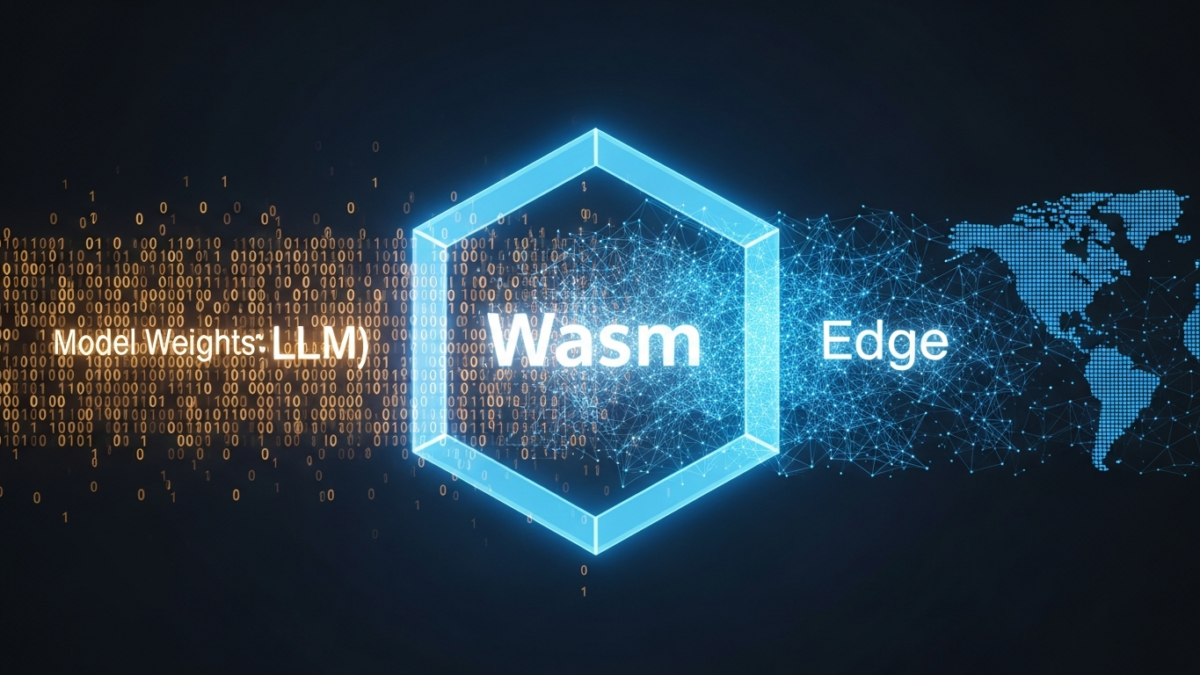
WebAssembly (Wasm) acts as the universal runtime glue to solve this. It offers the isolation of containers with the startup speed of serverless functions, making it the perfect candidate for running high-performance AI inference at the edge. In this article, we’ll explore how optimizing Wasm runtimes enables real-time LLM deployment outside the centralized cloud.
Why WebAssembly? Architectural Advantages for AI
Historically, WebAssembly was viewed as a compile target for browser-based games and applications. However, the 2023 State of WebAssembly Report highlights a massive shift: over 75% of surveyed developers are now utilizing Wasm for server-side and edge use cases. The primary drivers? Portability and security.
Near-Native Speed
While Python remains the lingua franca of AI research, it is an interpreted language ill-suited for the high-frequency demands of inference on edge hardware. Wasm compiles to low-level machine instructions, allowing languages like C++ or Rust-based inference engines (such as llama.cpp) to execute at near-native speeds. This ensures that the mathematical operations required for token generation happen as fast as the hardware allows, without the overhead of an interpreter.
Sandboxing and Security
Running untrusted models on shared edge infrastructure is a security risk. Wasm addresses this with a capability-based security model and strict sandboxing. A Wasm module cannot access the host’s file system, network, or memory unless explicitly granted permission. This isolation is critical when deploying third-party AI models to multi-tenant serverless edge environments.
Portability: “Write Once, Run Anywhere”
Dependency hell is a major pain point in MLOps. A model running on a specific version of CUDA in a Docker container might refuse to run on a different edge device. Wasm binaries are standalone. You can compile an AI application once and deploy the exact same artifact on AWS Lambda, Cloudflare Workers, a Raspberry Pi, or inside a smart vehicle without refactoring or managing complex environment dependencies.
The Stack: WASI-NN and Modern Wasm Runtimes
WebAssembly wasn’t originally designed with AI in mind, but the ecosystem has evolved rapidly. The key enabler for this evolution is the WebAssembly System Interface for Neural Networks (WASI-NN).
WASI-NN is a standard proposal that allows Wasm modules to execute inference computations via standardized bindings to backends like PyTorch, TensorFlow, OpenVINO, or even llama.cpp itself. It abstracts the underlying hardware (GPU, NPU, TPU) from the application code. You don’t need to rewrite your Wasm app if you switch from running on a CPU to an NPU; WASI-NN handles the translation.
The Runtime Showdown
While several runtimes exist, WasmEdge has emerged as the frontrunner for AI workloads. It was specifically designed with a plug-in architecture that supports WASI-NN out of the box. WasmEdge allows developers to load popular GGUF (GPT-Generated Unified Format) models—standard for llama.cpp—directly into the sandbox. Other runtimes like Wasmtime are catching up, but WasmEdge currently offers the most mature tooling for running LLMs.
The GGUF Ecosystem
The convergence around the GGUF file format is crucial for Wasm adoption. GGUF is designed for fast loading on limited hardware. It allows the weights of a model (like Llama-3-8B) to be memory-mapped, meaning the Wasm runtime can start serving requests almost instantly without loading the entire model into RAM upfront.
Optimization Strategies for Real-Time Inference
Merely running an LLM inside Wasm isn’t enough; it needs to be fast enough for conversational use cases. To achieve real-time performance (sub-100ms time-to-first-token), engineers must employ specific optimization strategies.
SIMD: The Engine of Matrix Math
At the heart of every LLM is matrix multiplication. This is a highly parallelizable task. Wasm SIMD (Single Instruction, Multiple Data) instructions allow the CPU to perform the same operation on multiple data points simultaneously. Enabling SIMD in your Wasm runtime is mandatory; without it, inference speeds can be up to 10x slower, making real-time chat impossible. Modern runtimes like WasmEdge automatically utilize SIMD extensions (AVX2/AVX-512 on x86, NEON on ARM) to accelerate these calculations.
Memory Management and Linear Memory
WebAssembly uses a linear memory model—a contiguous block of bytes that acts like a raw heap. This is actually an advantage for AI. Passing large tensors (multi-dimensional arrays of data) between the host machine and the Wasm module is efficient because you are essentially passing a pointer to shared memory. This zero-copy approach significantly reduces the overhead of data transfer compared to standard RPC calls often used in microservices architectures.
Quantization Trade-offs
Memory is the limiting factor at the edge. Standard 16-bit (FP16) models are massive. The industry has rapidly moved toward quantization—compressing model weights to lower precision. Running a model in 4-bit (INT4) format can reduce memory footprints by 4x with minimal loss in accuracy.
For example, Meta’s Llama-3-8B-Instruct model fits comfortably into ~5GB of RAM when quantized to Q4_K_M format. This is critical because most serverless function memory limits (and consumer edge devices) sit right around that 4GB-6GB threshold. Quantization makes it possible to run a capable 8-billion parameter model on standard serverless hardware, a feat impossible with full-precision weights.
Implementation Guide: Deploying a Llama-3 Chatbot on a Wasm Function
Let’s look at how you would actually deploy this. We will use Rust, WasmEdge, and the GGUF format of Llama-3-8B.
Step 1: Model Preparation
First, download the quantized model. You want the Q4_K_M version for the best balance of speed and memory usage.
# Example using huggingface-cli
wget https://huggingface.co/MaziyarPanahi/Llama-3-8B-Instruct-GGUF/resolve/main/Llama-3-8B-Instruct.Q4_K_M.gguf
Step 2: The Rust Wrapper
You write your application logic in Rust. Instead of binding directly to C++ libraries, you use the WasmEdge SDK, which exposes the WASI-NN API.
use wasmedge_sdk::{
    error::HostFuncError, VmBuilder, WasmVal, config::{CommonConfigOptions, ConfigBuilder, HostRegistrationConfigOptions},
    wasi::WasiModule,
};
use wasmedge_sys::WasmValue;

fn main() -> Result<(), Box> {
    // 1. Setup WasmEdge configuration with NN support
    let config = ConfigBuilder::new(CommonConfigOptions::default())
        .with_host_registration_config(HostRegistrationConfigOptions::default().wasi(true))
        .build()?;

    // 2. Initialize VM
    let vm = VmBuilder::new().with_config(config).build()?;

    // 3. Register the Wasi-NN plugin and load the GGUF model
    // This is a conceptual representation of loading the model via preload
    let model_path = "Llama-3-8B-Instruct.Q4_K_M.gguf";

    // In a real deployment, you pass the model graph to the execution context
    let wasi_nn_module = vm.wasi_nn_module()?;

    // Load the graph (model)
    let graph = wasi_nn_module.load(
        &[&std::path::PathBuf::from(model_path)],
        wasmedge_types::wasi_nn::TensorType::F32,
    )?;

    println!("Model loaded successfully. Initializing inference session...");

    // 4. Initialize a context for inference
    let ctx = graph.init_execution_context()?;

    // 5. Set input (Prompt)
    let prompt = "Explain WebAssembly in one sentence.";
    ctx.set_input(0, prompt.as_bytes())?;

    // 6. Execute inference
    ctx.compute()?;

    // 7. Retrieve output
    let mut output_buffer = vec![0u8; 1024];
    let bytes_written = ctx.get_output(0, &mut output_buffer)?;

    let response = String::from_utf8_lossy(&output_buffer[..bytes_written]);
    println!("LLM Response: {}", response);

    Ok(())
}
Step 3: Serverless Deployment
Compile the Rust code to Wasm using cargo build --target wasm32-wasi. You now have a .wasm file. You can deploy this binary to any Wasm-compatible serverless platform, such as Second State, Flows.network, or a standard Docker container with the WasmEdge runtime embedded. The deployment is simply moving the binary and the GGUF model file.
Future Outlook: The Hybrid AI Architecture
We are moving toward a hybrid AI architecture. WebAssembly enables a tiered inference approach where small, quantized “draft” models (like Phi-3 or TinyLlama) run locally on the device to handle simple queries immediately. If the query exceeds the capability of the edge model, the Wasm runtime can make a secure, context-aware call to a larger cloud model.
Furthermore, the integration of WebGPU with Wasm is the next frontier. This standard allows Wasm code to access local GPUs directly within the browser. This means privacy-preserving, high-performance AI inference will soon be possible not just on servers, but on every user’s laptop and phone, democratizing access to high-performance AI compute.
Key Takeaways
- Performance: Wasm effectively eliminates the cold-start bottlenecks of containers, allowing AI models to start in milliseconds.
- Efficiency: Combining Wasm’s linear memory with 4-bit quantization (INT4) allows powerful 8B parameter models to run on resource-constrained edge devices.
- Standards: WASI-NN is maturing into the standard interface for running AI, decoupling the application code from the underlying hardware backend (PyTorch, OpenVINO, etc).
By shifting inference from the cloud to the edge with Wasm, we aren’t just saving latency; we are building a more private, secure, and resilient infrastructure for the next generation of intelligent applications.
Get the next deep dive before it hits search.
RodyTech publishes practical writing on AI systems, infrastructure, and software that teams can actually ship. Subscribe for new posts without waiting for an algorithm to surface them.
- One useful email when a new article is worth your time
- Hands-on notes from real builds, deployments, and ops work
- No generic growth funnel copy, just the writing


No comments yet