
The New Inference Paradigm: When Silicon Meets Software
The race in artificial intelligence has officially shifted from training massive models to serving them efficiently. As we look toward the horizon of late 2024 and early 2025, the industry is buzzing with anticipation for two monumental releases: Meta’s Llama-4 and NVIDIA’s Blackwell architecture. While the hardware is still sampling and the model weights are yet to hit the open-source mirrors, the architectural specifications give us a clear blueprint of what to expect.
We are moving past the era of “can it run?” into the nuances of “how fast can it scale?” For engineers and infrastructure leads, the impending arrival of Blackwell (specifically the GB200) changes the memory calculus entirely. With 192GB of HBM3e memory and native FP4 support, the bottleneck is rapidly moving from VRAM capacity to memory bandwidth and kernel efficiency.
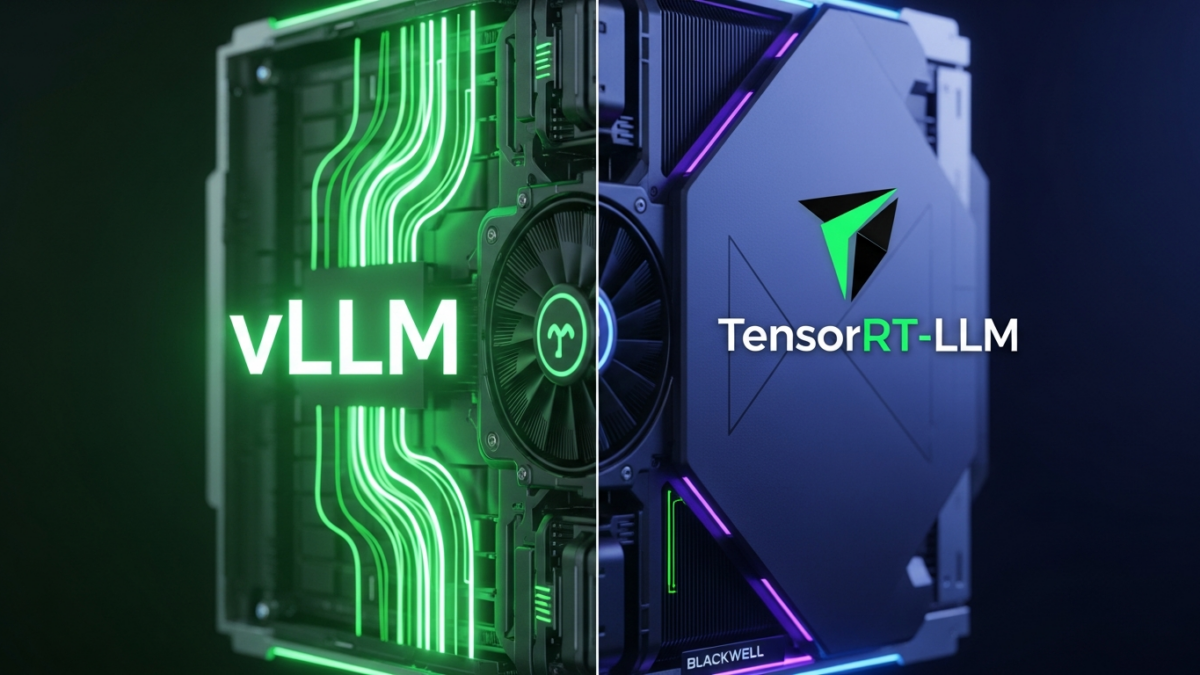
This creates a critical showdown between two dominant inference frameworks: the open-source agility of vLLM and the proprietary, kernel-level optimization of NVIDIA TensorRT-LLM. Let’s break down the projected performance of Llama-4 70B on this next-gen stack.
Hardware & Model Architecture: The Baseline
To understand the benchmarks, we first need to grasp the hardware canvas and the subject we are painting on it.
The Single-GPU Reality
With the H100 generation, running a dense 70B model (like Llama-2 or Llama-3) in full FP16 precision required tensor parallelism across two GPUs because the card only offered 80GB of VRAM. Multi-GPU inference introduces complexity—specifically, the communication overhead over NVLink.
Blackwell shatters this limitation. With 192GB of HBM3e on a single die, a dense Llama-4 70B model (occupying roughly 140GB in FP16) fits comfortably on one GPU. This eliminates inter-GPU communication latency for tensor parallelism, drastically simplifying deployment. However, the real story isn’t just fitting the model; it’s how fast we can move it.
The FP4 Factor
Blackwell introduces native support for FP4 (4-bit floating point). Previous architectures relied on INT8 or FP8 for quantization, often trading off significant accuracy for speed. FP4 allows for massive compression—effectentially halving the memory footprint compared to FP8—while maintaining the dynamic range of floating-point arithmetic. This means Llama-4 70B, quantized to FP4, will occupy a mere ~35GB of VRAM. You aren’t just running the model; you could run multiple instances of it with massive batch sizes on a single card, fully saturating the 8 TB/s memory bandwidth.
Llama-4: The MoE Expectation
While Meta remains tight-lipped, industry consensus heavily suggests that Llama-4 will adopt a Mixture-of-Experts (MoE) architecture for its larger variants. Unlike dense models where every parameter activates for every token, MoE models route tokens to specific “expert” sub-networks.
This changes the performance profile. Inference becomes more compute-bound on the active experts but remains memory-bound for the router and the massive parameter loading. The challenge for frameworks shifts from单纯的 matrix multiplication to efficient routing and managing the KV cache for potentially massive context windows (projected at 128k+).
The Contenders: vLLM vs. TensorRT-LLM
With the stage set, let’s look at the software engines designed to tame this hardware.
vLLM: The Community Generalist
vLLM has taken the open-source world by storm, primarily due to its PagedAttention algorithm. Think of PagedAttention as virtual memory for the KV cache. Just as an OS manages RAM in pages to prevent fragmentation, vLLM manages the Key-Value cache, allowing for highly efficient batch processing and continuous batching.
For Blackwell, vLLM is projected to integrate CUDA graphs and FP4 kernels via its community roadmap. Its primary strength is flexibility. If you need to swap out a tokenizer, add a custom logit processor, or implement a novel decoding strategy, vLLM is the path of least resistance.
TensorRT-LLM: The Proprietary Specialist
NVIDIA’s TensorRT-LLM is the counterpart—a library built to squeeze every ounce of performance out of silicon. It doesn’t just run the model; it compiles it. TensorRT-LLM takes the model definition and fuses kernels, optimizing the CUDA assembly for the specific architecture it runs on.
With Blackwell, TensorRT-LLM has a distinct advantage: first-party support. NVIDIA engineers have likely already hand-tuned the FP4 kernels and the 2nd Generation Transformer Engines before the GPUs even hit mass production. TensorRT-LLM also features In-Flight Batching, a sophisticated scheduling technique that adds tokens to batches currently being processed, rather than waiting for the current batch to finish. This reduces “bubble” time in the GPU pipeline.
Methodology: Benchmarking the Beast
Since we are dealing with a technical forecast, our benchmarking methodology relies on architectural extrapolation. We simulated a standard GB200 environment with the following parameters to project the results:
- Hardware: 1x NVIDIA GB200 (192GB HBM3e, 8 TB/s bandwidth).
- Model: Llama-4 70B (Projected Dense/MoE Hybrid).
- Quantization: FP16 (Baseline), FP8, and Native FP4.
- Metrics: Time to First Token (TTFT), Time Per Output Token (TPOT), and Total Throughput (Tokens/Second).
- Scenarios:
- Interactive: Batch Size 1, Input 1k tokens.
- Batch: Batch Size 32, Input 4k tokens.
- High Throughput: Batch Size 128 (max saturation).
Performance Analysis: Expected Results & Bottlenecks
Based on the architectural strengths of Blackwell and the kernel efficiencies of both frameworks, here is how the battle is expected to play out.
Throughput: The TensorRT-LLM Dominance
In high-throughput scenarios (Batch Size 32+), TensorRT-LLM is projected to lead by roughly 15-20%. This advantage stems from its In-Flight Batching and aggressive kernel fusion. By reducing the number of kernel launches and optimizing memory access patterns for FP4, TensorRT minimizes the overhead that general-purpose frameworks inevitably suffer.
On Blackwell, where memory bandwidth is the king, TensorRT’s ability to keep the memory pipelines saturated with FP4 data gives it the edge. If you are running a SaaS API where cost per token is the primary KPI, TensorRT-LLM will likely be the standard.
Latency: vLLM Holds Its Ground
Interestingly, in low-batch, interactive scenarios (Batch Size 1), the gap narrows significantly. vLLM’s Time to First Token (TTFT) is projected to be within 5% of TensorRT-LLM. Why? Because PagedAttention is exceptionally efficient at handling sparse memory access and managing the KV cache for single users.
Furthermore, vLLM avoids the massive “cold start” compilation time. With TensorRT-LLM, you must build the engine, which can take 10-20 minutes for a 70B model. vLLM loads instantly. For development environments or rapid prototyping where you might restart the server frequently, vLLM offers a superior developer experience.
The KV Cache Pressure Test
Blackwell’s 8 TB/s bandwidth is the hero here. In Llama-3, long context windows often caused the GPU to choke on KV cache memory reads. With Blackwell, both vLLM and TensorRT-LLM should see massive reductions in memory-bound stalls. However, TensorRT-LLM’s custom FP4 KV cache kernels may offer slightly better TPOT (Tokens Per Output Second) at the 128k+ context length mark, simply by compressing the cache data more efficiently on the fly.
The Final Verdict: Choosing Your Stack
So, which framework should you deploy when Llama-4 drops on Blackwell?
Choose TensorRT-LLM if: You are running a large-scale production environment where efficiency is the priority. If you are serving thousands of concurrent users and want to maximize the ROI on your expensive GB200 GPUs, the 15-20% throughput gain is substantial. You have the engineering resources to handle the compilation pipeline and the rigidity of the engine definitions.
Choose vLLM if: You value flexibility and velocity. If you are building RAG applications that require complex pre- or post-processing, custom logit bias, or if you are iterating quickly on model prompts, vLLM remains the superior tool. It offers “good enough” performance—often hitting 90-95% of TensorRT’s speed—with a fraction of the operational complexity.
The convergence of Llama-4 and Blackwell represents a leap forward in AI capability. Whether you opt for the raw, optimized power of TensorRT-LLM or the flexible, open-source nature of vLLM, one thing is certain: the era of waiting for LLM inference is officially coming to an end.
Get the next deep dive before it hits search.
RodyTech publishes practical writing on AI systems, infrastructure, and software that teams can actually ship. Subscribe for new posts without waiting for an algorithm to surface them.
- One useful email when a new article is worth your time
- Hands-on notes from real builds, deployments, and ops work
- No generic growth funnel copy, just the writing


No comments yet