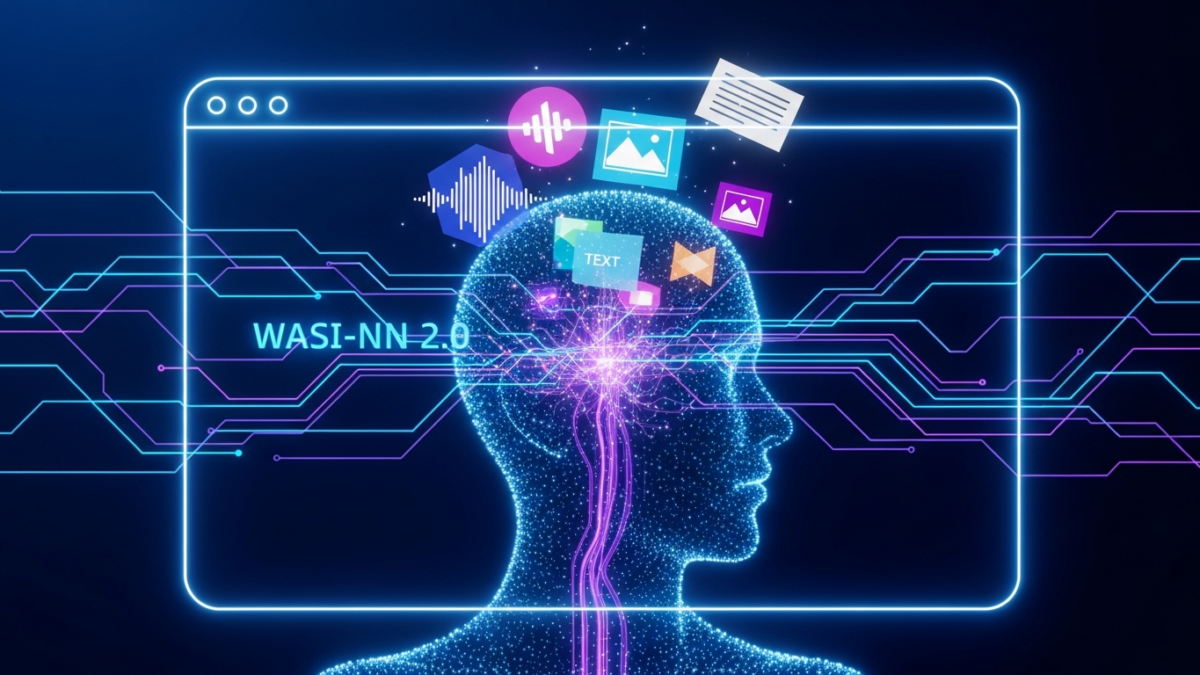

For years, the browser has been a render engine—a thin client that displays content while the heavy lifting happens on a server somewhere in the cloud. But as we move into the era of agentic AI, that architecture is hitting a wall. Sending every image frame, audio snippet, or user prompt to a centralized API introduces latency, incurs massive costs, and creates significant privacy risks. We need a smarter way to process data where it lives: on the user’s device.
Enter WebAssembly (Wasm). While most developers know Wasm as a way to run C++ or Rust in the browser at near-native speed, a lesser-known evolution is turning it into a powerhouse for Artificial Intelligence. This evolution centers around WASI-NN (Neural Network), a standard interface for WebAssembly to interact with AI models.
With the recent updates to the proposal—often conceptualized as WASI-NN 2.0—we are seeing a leap forward in capability. We are no longer talking about simple classification tasks; we are talking about running complex, multi-modal agents that can see, hear, and reason directly in the browser with 90-95% of native performance. Let’s unpack how this technology works and why it matters for the future of the web.
The Shift to “Edge-First” AI Agents
The current paradigm for AI development is heavily reliant on the cloud. You build an application that captures user input, sends it to an OpenAI or Anthropic API, waits for a response, and renders the result. For text-based chatbots, this is acceptable. But for “agents”—systems that interact with the real world via video, audio, and sensor data—the latency is debilitating.
Imagine a vision agent that analyzes a user’s screen to provide real-time assistance. If every screenshot requires a round-trip to a data center, the interaction lag makes the tool unusable. Furthermore, constantly streaming video or audio from a user’s device raises immediate red flags regarding data privacy.
The solution is the Edge-First Agent. This architecture moves the inference engine to the client side. The AI processes data locally on the device. The benefits are threefold:
- Latency: Zero network lag for inference processing.
- Privacy: Sensitive data never leaves the device.
- Cost: Developers eliminate massive API bills for high-volume tasks.
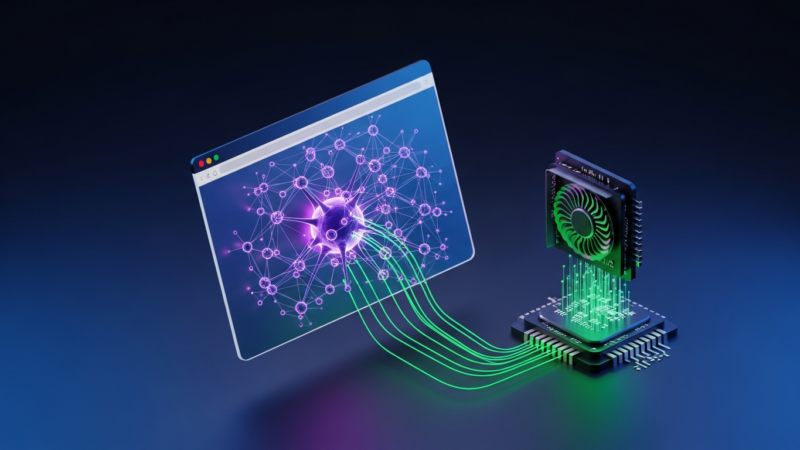
However, running deep learning models in a browser environment is notoriously difficult. JavaScript is too slow for heavy number crunching, and WebGPU, while promising, is still a moving target for high-level model integration. This is where WebAssembly and the WASI standard enter the chat, providing a sandboxed, high-performance runtime that bridges the gap between web code and hardware acceleration.
Deconstructing WASI-NN 2.0 (The “Next Gen” Spec)
WASI-NN stands for WebAssembly System Interface – Neural Network. It provides a standard API for Wasm modules to load, configure, and execute machine learning models. Initially, the proposal (version 0.1) was functional but limited. It relied on synchronous execution, meaning the main thread was blocked while the model computed an answer. In a browser environment, this is a death sentence; a blocking call freezes the UI, making the application feel unresponsive.
The shift to WASI-NN 0.2+ (conceptually the 2.0 era) fixes this fundamental flaw by introducing asynchronous, non-blocking execution and streaming outputs. This architectural shift is critical for UI responsiveness. Instead of waiting for a full sentence to be generated, the browser can start rendering tokens as they are produced, similar to how ChatGPT streams text, but entirely client-side.
The Standard API Flow
The beauty of WASI-NN lies in its abstraction. It separates the application code from the backend inference engine. The standard flow generally follows these steps:
- Loading: The application calls
loadto build a computation graph from model bytes or a URI (e.g., a GGUF file). - Setting Input: The
set_inputfunction handles tensors. This is where you feed text, audio buffers, or image data into the model context. - Inference: The
computefunction runs the model. In WASI-NN 2.0, this is non-blocking. The host runtime handles the threading, allowing the Wasm module to yield control back to the browser event loop.
Because this is a standard, your code does not care which engine runs the math. You could write your agent once, and it could run on WasmEdge, Wasmer, or Wasmtime without modification, preventing vendor lock-in.
The Backend Engine Room (GGML & OpenVINO)
While WASI-NN provides the steering wheel, the engine is what determines speed. WASI-NN abstracts the backend, allowing developers to swap inference engines dynamically. The most exciting development in this ecosystem is the robust support for GGML.
GGML is a C library designed specifically for machine learning on commodity hardware. It is the magic behind llama.cpp and the massive popularity of running LLaMA models on laptops. With the WASI-NN GGML backend, developers can now run these quantized models (GGUF format) directly inside a WebAssembly runtime.
Performance is achieved through a technique called zero-copy memory mapping. WASI-NN maps the Wasm memory directly to the GGML tensor context. This eliminates the need to serialize data or copy memory buffers between the JavaScript host and the Wasm guest, drastically reducing overhead.
Hardware Acceleration
Beyond efficient memory usage, WASI-NN 2.0 delegates to specific hardware instructions available on the user’s CPU:
- AVX-512/AVX2: utilized on x86 architectures (Intel/AMD) to process multiple data points in a single clock cycle.
- NEON: leveraged on ARM architectures (Apple Silicon, mobile devices) for similar parallel processing gains.
- WebGPU: While still maturing, the roadmap includes tighter integration with WebGPU to offload matrix multiplication to the GPU, enabling mobile browser execution.
Other supported backends include OpenVINO (for Intel optimization), PyTorch (via libtorch), ONNX, and TensorFlow Lite. This flexibility allows developers to choose the runtime that best fits their target hardware and model requirements.
Implementing Multi-Modal Capabilities
The true potential of WASI-NN 2.0 is unlocked when building Multi-Modal Agents. These are systems that can process and synthesize different types of data simultaneously—text, vision, and audio. Recent integrations in the WasmEdge ecosystem now support complex models like LLaVA (Large Language and Vision Assistant) and Whisper directly in the browser.
How It Works
Building a visual agent involves a specific pipeline. First, the application captures raw image data—perhaps from a file upload or an HTML5 Canvas. Instead of sending this image to a server, the application passes the raw bytes into the WASI-NN context.
Inside the model (like LLaVA), a Vision Transformer (ViT) or CLIP encoder processes these pixels to convert them into high-dimensional vector embeddings. These embeddings are then projected into the space of the Language Model (LLM). The LLM treats these image vectors just like text tokens, allowing it to “reason” about what it sees and generate a textual description or answer.
// Conceptual Logic for a Browser-Based Multi-Modal Agent

// 1. Load the GGUF model (Llava-v1.5-7b)
const graph = await wasi_nn.load("Llava-v1.5-7b-quantized.gguf", "GGML");

// 2. Capture image bytes from a canvas
const imageData = ctx.getImageData(0, 0, width, width);
const imageBytes = convertToRawBytes(imageData);

// 3. Set inputs (Image + Text Prompt)
wasi_nn.set_input(graph, 0, imageBytes); // Image tensor
wasi_nn.set_input(graph, 1, encodeText("Describe this image:")); // Text tensor

// 4. Compute Asynchronously
const context = await wasi_nn.compute(graph);

// 5. Stream the output
for await (const token of wasi_nn.get_output_single(context)) {
    updateUI(token);
}
This architecture enables agents that can “watch” a video stream in real-time, analyze complex diagrams without uploading proprietary data, or process voice commands locally using Whisper—all via the same standardized API.
Benchmarks – Near-Native Speed Reality Check
Promises of speed are common in tech, so let’s look at the data. Benchmarks from leading runtimes like WasmEdge indicate that when utilizing WASM SIMD (Single Instruction, Multiple Data) instructions and hardware acceleration, WebAssembly inference achieves 90-95% of native performance.
To put that in perspective:
- Native Python (PyTorch): Baseline 100%.
- Docker Container: Slight overhead (~95%).
- WasmEdge + WASI-NN: ~90-95% performance with significantly lower cold-start times.
The overhead is negligible for most consumer applications. However, where WASI-NN truly beats native Python is in Cold Start Times. A Python container might take seconds to initialize libraries and load the runtime. A Wasm module starts in milliseconds. This makes WASI-NN ideal for serverless functions or burst-traffic scenarios where containers are constantly spinning up and down.
Furthermore, memory footprint is often more deterministic in Wasm. Compared to a standard Python process with its garbage collection cycles, Wasm’s linear memory management allows for more predictable real-time performance, essential for keeping a browser UI smooth during heavy computation.
Future Roadmap and Developer Implications
As we look toward the future, the roadmap for WASI-NN (moving toward version 0.3 and beyond) focuses on “Pluggable Backends” and enhanced security. We can expect to see better tooling for custom operators and stricter protocols for secure model loading, ensuring that models aren’t tampered with during transit.
For developers, this signifies a fundamental shift in how we build the web. We are moving toward an “Agent-First” web. In this new paradigm, HTML and JavaScript handle the presentation and user interaction, while WASM and WASI-NN handle the “brain.”
This eliminates the need for backend inference APIs for a vast array of consumer applications. Startups can deploy intelligent, reactive applications that run entirely on the user’s device, reducing infrastructure costs to near zero for the inference layer. It democratizes AI, allowing powerful agents to run on high-end consumer laptops, edge gateways, and eventually, mobile phones, independent of cloud connectivity.
Key Takeaways
- WASI-NN 2.0 introduces async execution and streaming, fixing the UI-blocking issues of earlier versions and making browser inference viable.
- Multi-Modal Agents can now run locally using models like LLaVA and Whisper, processing vision and audio without server round-trips.
- GGML and WASM SIMD enable 90-95% of native performance, utilizing AVX-512, NEON, and GPU acceleration for speed.
- Privacy and Cost are significantly improved by moving processing to the edge, keeping data local and reducing API dependency.
- The Future is an Agent-First Web where Wasm handles the intelligence, reducing the reliance on centralized cloud GPUs for consumer apps.
Ready to start building edge-native agents? The tools are here, the performance is real, and the browser is ready for its brain transplant. Dive into the WasmEdge documentation or the WASI-NN proposal repository to get your hands dirty with the next generation of Web AI.
Get the next deep dive before it hits search.
RodyTech publishes practical writing on AI systems, infrastructure, and software that teams can actually ship. Subscribe for new posts without waiting for an algorithm to surface them.
- One useful email when a new article is worth your time
- Hands-on notes from real builds, deployments, and ops work
- No generic growth funnel copy, just the writing
No comments yet