
It’s 3:00 AM. Your phone buzzes on the nightstand. It’s PagerDuty. A critical deployment pipeline has failed, blocking the release scheduled for the morning launch. You stumble out of bed, open your laptop, and stare at the logs. It’s a transient timeout—something that would resolve itself if you just hit the “retry” button. But the system didn’t know that. It just alerted you.
This scenario is all too familiar. According to the DORA 2023 State of DevOps Report, while elite performers maintain a low change failure rate, lower-tier teams see failure rates exceeding 30%. For large enterprises, an hour of CI/CD downtime can cost over $100,000 in lost productivity. The real culprit often isn’t complex architecture failures but simple “noise”—flaky tests, momentary network blips, or resource contention.
Traditionally, we’ve relied on AIOps tools that monitor systems and scream for help when something breaks. But the next evolution of DevOps isn’t about smarter monitoring; it’s about autonomous action. By combining the mechanical precision of Kubernetes Operators with the reasoning capabilities of Agentic AI, we can move from passive alerting to active, self-healing pipelines.
The Architecture: Brains (AI) and Hands (Operators)
To understand how to build a self-healing pipeline, we need to look at the distinct roles of two technologies. Kubernetes Operators act as the “hands” or the enforcers of the cluster. Built on the Operator Pattern, they extend the Kubernetes control plane to manage complex applications. They follow a continuous loop: Observe (check current state) → Diff (compare desired state) → Act (reconcile the difference).
Traditionally, the logic inside the “Act” phase is hard-coded. If the Pod crashes, restart it. If the disk is full, alert. This works well for known states but fails when the error is unexpected.
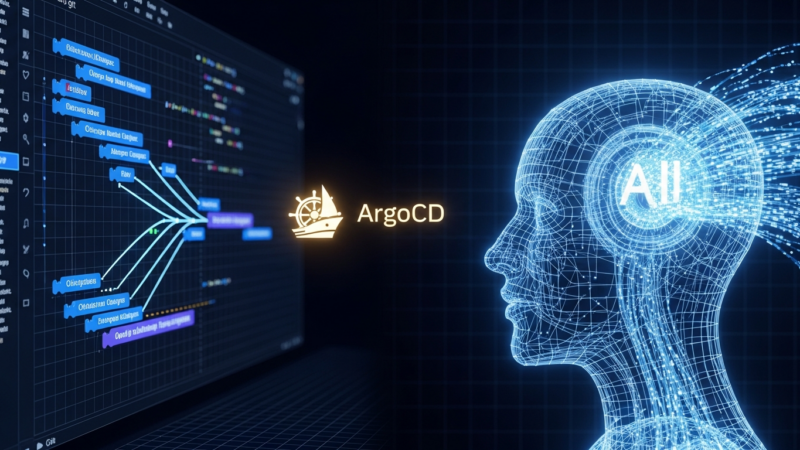
This is where Agentic AI enters as the “brain.” Unlike standard copilots that merely suggest code snippets, Agentic AI (using systems like OpenAI’s function calling or LangChain) can understand context and execute tools autonomously. In this architecture, the Operator detects a failure but pauses before acting. It sends the logs and metrics to the AI Agent and asks: “I found this error. What should I do?”
The AI analyzes the stack trace, consults the documentation, and formulates a plan. It returns a specific command—like a YAML patch or a bash script—which the Operator then executes. This creates a powerful feedback loop where the system reasons through the problem rather than following a static script.
Designing the Self-Healing CRD
To implement this, we need a way to define the rules of engagement for our AI. We can’t simply give an LLM unrestricted access to our production cluster; that would be a security nightmare. Instead, we define a Custom Resource Definition (CRD) called PipelineRecoveryPolicy.
This CRD acts as a guardrail, explicitly defining what the AI is allowed to touch. Here is a conceptual example of how this YAML structure might look:
apiVersion: rodytech.ai/v1alpha1
kind: PipelineRecoveryPolicy
metadata:
  name: backend-build-healer
spec:
  targetPipeline: "backend-ci-build"
  failureThreshold: 2
  allowedStrategies:
    - "retry_stage"
    - "increase_memory"
    - "patch_dependency_version"
  safetyChecks:
    dryRun: true
    maxRetries: 3
In this definition, we set the targetPipeline and the failureThreshold (how many times it can fail before the AI intervenes). Crucially, the allowedStrategies field limits the Agent. If the AI decides the best fix is to delete the production database, it can’t, because that strategy isn’t listed. The safetyChecks ensure that the first attempt is always a dryRun, applying the change only if the diff looks safe.
Engineering the Agentic Loop
Building this requires a standard Kubernetes Operator framework. We can use Kubebuilder (Go) or Kopf (Python). Below is a simplified Go snippet illustrating how the Reconcile loop might pause to query an AI agent.
func (r *PipelineReconciler) Reconcile(ctx context.Context, req ctrl.Request) (ctrl.Result, error) {
    // 1. Fetch the Pipeline status
    pipeline := &cicdv1.Pipeline{}
    if err := r.Get(ctx, req.NamespacedName, pipeline); err != nil {
        return ctrl.Result{}, client.IgnoreNotFound(err)
    }

    // 2. Check for failure condition
    if pipeline.Status.Phase == "Failed" {
        // 3. Prepare Context (Logs, Error Message)
        logs := r.getPodLogs(ctx, pipeline.Name)
        contextData := fmt.Sprintf("Pipeline failed with error: %s. Logs: %s", pipeline.Status.Message, logs)

        // 4. Call the Agentic AI (simulated function)
        decision, err := r.AIClient.QueryForFix(ctx, contextData)
        if err != nil {
            // Fallback to human alert if AI fails
            return r.alertHuman(ctx, pipeline)
        }

        // 5. Apply the decision (e.g., Retry, Patch)
        if decision.Action == "Retry" {
            return r.retryPipeline(ctx, pipeline)
        } else if decision.Action == "PatchResource" {
            return r.applyPatch(ctx, decision.Patch)
        }
    }

    return ctrl.Result{RequeueAfter: time.Minute * 5}, nil
}
The critical piece here is the QueryForFix method. This function handles Context Injection. It takes the raw logs and formats them into a prompt optimized for an LLM. The system prompt might look like this: “You are a senior DevOps engineer. Analyze the following error logs from a Kubernetes CI job. If the error indicates ‘OutOfMemory’, return a JSON object with action ‘ScaleUp’. If it is a network timeout, return ‘Retry’. Do not suggest actions that involve data loss.”
Through Function Calling, the LLM doesn’t just return text; it returns a structured JSON object that the Go code can execute directly. This bridges the gap between natural language reasoning and binary execution.
Real-World Scenarios and Failure Modes
How does this behave in production? Let’s look at two common scenarios. Scenario A: The Flaky Test. Meta Engineering studies show flaky tests account for 10-15% of all failed builds. Usually, a developer has to manually re-run the job. In our Agentic system, the Operator detects the specific test failure signature (e.g., a race condition in the log). The AI identifies it as a transient issue and triggers the retry_stage tool. The developer wakes up to a green build, never knowing a failure occurred.
Scenario B: Resource Exhaustion. A compilation job fails with exit code 137 (OOM Killed). The Operator scrapes the metrics, sees memory usage hit the limit, and asks the AI for help. The AI responds with a patch to increase the memory request in the Job definition. The Operator applies the patch, and the job restarts with higher limits, succeeding on the second try.
However, we must address the Hallucination Risk. What if the AI misinterprets a log and suggests a destructive patch? This is why the PipelineRecoveryPolicy is vital. Furthermore, we implement a validation step. Every AI-generated patch must pass a kubectl diff --dry-run check. If the diff is too large or touches forbidden fields (like environment variables containing secrets), the system halts and alerts a human SRE.
The Future: Autonomous DevOps
The rise of Agentic AI in infrastructure signals a shift in the SRE role. As Gartner predicts, by 2028, AI agents will manage most deployments. This moves engineers away from “toil”—repetitive, manual work—toward policy definition and architecture. The future of DevOps isn’t managing pipelines; it’s designing the “brains” that manage them.
We will likely see the rise of AI-powered Internal Developer Platforms (IDPs) where developers simply describe their deployment goals, and the Agentic Operators handle the implementation, monitoring, and healing automatically.
Key Takeaways
- Shift from Passive to Active: Traditional AIOps alert you; Agentic Ops fixes the issue by combining LLM reasoning with Kubernetes execution.
- Safety First: Always use a CRD (like
PipelineRecoveryPolicy) to restrict the AI’s actions and enforce dry-run validation to prevent accidental damage. - Start Small: Begin by automating simple recovery strategies (retries and resource scaling) before granting the agent access to complex configuration changes.
Ready to stop waking up at 3 AM? Start experimenting with LangChain’s Kubernetes tools and your own custom Operators today.
Get the next deep dive before it hits search.
RodyTech publishes practical writing on AI systems, infrastructure, and software that teams can actually ship. Subscribe for new posts without waiting for an algorithm to surface them.
- One useful email when a new article is worth your time
- Hands-on notes from real builds, deployments, and ops work
- No generic growth funnel copy, just the writing
No comments yet