The shift from passive chatbots to “agentic” AI systems is well underway. We are no longer just asking Large Language Models (LLMs) questions; we are tasking them with goals, equipping them with tools, and allowing them to execute multi-step reasoning loops to get the job done. But while the capabilities of these autonomous agents are skyrocketing, the infrastructure required to run them is lagging behind.
Many engineering teams are still managing their AI workloads with brittle scripts or manual console clicks. This approach might work for a weekend hackathon, but it falls apart when you need to deploy a fleet of autonomous agents to production. This is where GitOps enters the chat. By applying the principles of declarative configuration and version control—specifically using ArgoCD—we can turn the chaotic world of Agentic Workflows into a predictable, reliable engineering discipline.
The Architecture: GitOps as the Control Loop for Agents
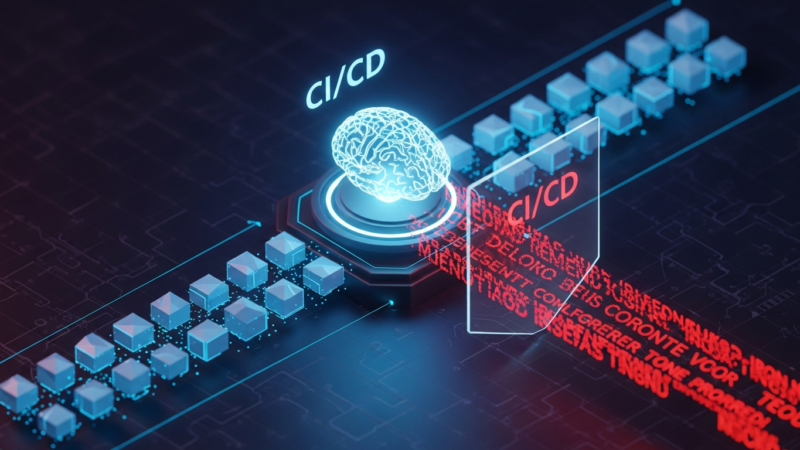
To understand why GitOps is vital for AI agents, we first need to look at how these systems are built. Modern agentic architectures often rely on complex stacks like Ray.io or KubeRay running on Kubernetes to manage distributed task execution. An agent isn’t just a container; it’s a “brain” (the model and prompt logic) attached to a “body” (the compute resources, sidecars, and tool connections).
In a traditional setup, updating an agent’s logic might involve SSH-ing into a server or manually updating a deployment script. In a GitOps model, we define the desired state of our agent in a Git repository. This includes everything: the Kubernetes Pod specifications, resource limits (GPU requests), and even the configuration parameters for the model itself.
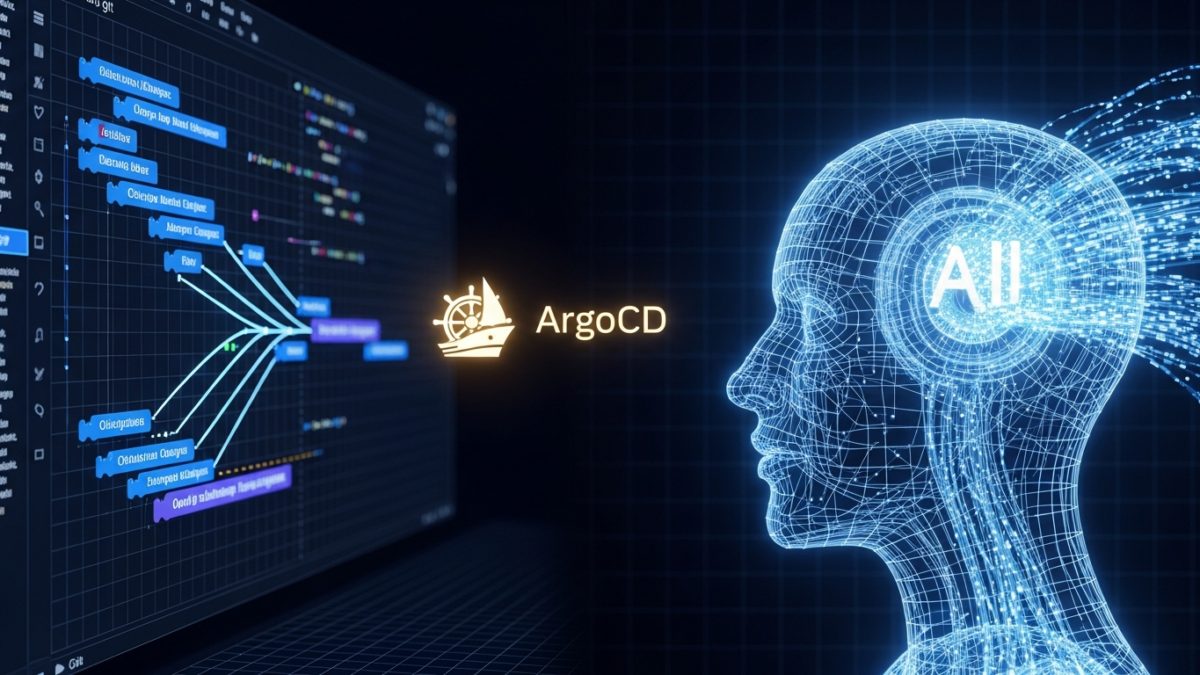
Git becomes the single source of truth. If it is not in Git, it does not exist. ArgoCD acts as the synchronization engine, continuously monitoring the cluster to ensure the running state matches the desired state defined in your YAML files. When you commit a change to your agent’s configuration, ArgoCD detects the drift and automatically reconciles the cluster.
Managing Non-Deterministic State: The GitOps Paradox
A common pushback against using GitOps for AI is the “state problem.” GitOps thrives on immutable infrastructure and declarative config, but AI agents are inherently stateful. They generate conversation logs, store short-term memories, and write embeddings to Vector Databases. You obviously cannot put gigabytes of vector data into a Git repository.
The solution lies in a strict separation of concerns. We use Git to manage the schema and the infrastructure, while external systems handle the data.
In your Git repo, you store the definitions for your Vector Database (e.g., a Helm chart for Weaviate or Milvus), the connection strings, and the model version tags. You do not store the actual embeddings or the chat history. ArgoCD manages the infrastructure supporting these stateful components. For example, you can use ArgoCD SyncWaves and health checks to ensure the Vector Database is fully healthy and ready to accept connections before spinning up the Agent pods that depend on it.
Versioning Prompts and Models: “Prompt Engineering as Code”
One of the most powerful aspects of this workflow is treating “Prompt Engineering” as actual code. In many organizations, prompts are treated as magic strings buried deep in Python code. This makes it difficult to track which prompt version caused a specific agent behavior.
By moving prompts into ConfigMaps or mounted files within your Kubernetes manifests, you can version control them effectively. You can see exactly who changed the system prompt, when they changed it, and what the previous version was.
apiVersion: v1
kind: ConfigMap
metadata:
  name: agent-prompts
  namespace: ai-workflows
data:
  system_prompt.txt: |
    You are a strict compliance officer for a financial institution.
    You must verify all transactions against the 2024 regulatory guidelines.
    If a transaction is suspicious, flag it immediately.
Using tools like Kustomize, you can even manage different prompts for different environments. You might want a “Creative Agent” for development that is more lenient, but a “Strict Compliance Agent” for production. With Kustomize overlays, you can swap out the `system_prompt.txt` file automatically based on the branch you are deploying.
Furthermore, consider a scenario where a new LLM version causes your agent to start producing toxic output. Without GitOps, rolling back involves a stressful manual intervention. With ArgoCD, it is a simple git revert. The synchronization loop instantly detects the change and reverts the deployment to the last known good state, often in a matter of seconds.
Securing the Autonomous Supply Chain
Autonomous agents need credentials to function. They need API keys for OpenAI or Anthropic, and they need access tokens to query internal tools. Committing these secrets to Git is a security nightmare.
A robust GitOps setup for AI integrates ArgoCD with external secrets managers like AWS Secrets Manager, Azure Key Vault, or HashiCorp Vault. ArgoCD can utilize tools like the External Secrets Operator to inject these secrets into the cluster at runtime. The Git repo only contains a reference to the secret, not the secret itself.
Security goes beyond just secrets management. It extends to policy enforcement. AI workloads are notoriously expensive because they require GPUs. You can use tools like OPA Gatekeeper or Kyverno alongside ArgoCD to enforce strict policies. For instance, you could create a policy that states: “No agent in the ‘development’ namespace is allowed to request GPU resources.” If a developer tries to commit a manifest requesting a GPU for a dev agent, the policy controller blocks it, and ArgoCD reports a sync error. This prevents runaway cloud bills before they happen.
The Future of Self-Healing AI
The ultimate promise of combining Agentic Workflows with GitOps is self-healing infrastructure. AI agents are experimental; they might crash because a tool API timed out, or a loop ran infinitely. In a traditional environment, a crashed agent might stay down until a developer notices.
With ArgoCD, the control loop is always watching. If an Agent container crashes, ArgoCD attempts to restart it or replace it to match the desired count defined in the repository. If a human engineer manually tweaks a setting in the cluster (perhaps trying to debug a live issue), ArgoCD will eventually notice the “configuration drift” and revert it to the state defined in Git. This ensures that your production environment remains immutable and auditable.
Key Takeaways
- Declarative AI: Treat your agents as standard Kubernetes workloads defined in YAML, not special snowflakes managed by scripts.
- Version Control Everything: Commit your prompts, model versions, and configuration alongside your application code.
- Separate State: Use Git for infrastructure definitions and external stores (Vector DBs, S3) for the actual data and embeddings.
- Automated Safety: Use policy engines to restrict resource usage (GPUs) and external secret managers to handle credentials safely.
GitOps transforms AI from a fragile science experiment into a production-grade engineering discipline. If you are looking to bring order to the chaos of autonomous agents, start by containerizing your workflow and letting ArgoCD take the wheel.
Ready to get started? Try containerizing a simple LangChain agent and deploying it to a local Kubernetes cluster using ArgoCD today. You will never look at model deployment the same way again.
Get the next deep dive before it hits search.
RodyTech publishes practical writing on AI systems, infrastructure, and software that teams can actually ship. Subscribe for new posts without waiting for an algorithm to surface them.
- One useful email when a new article is worth your time
- Hands-on notes from real builds, deployments, and ops work
- No generic growth funnel copy, just the writing
No comments yet