


In this article
A quiet modern Mac begins making the synthesized noises of mechanical storage. Elsewhere, a dial-up timeline can be interrupted by call waiting, a simulated lightning noise burst or someone lifting an extension phone. These are the kinds of details that animate Jason O’Connell’s Plain Weird, a collection he describes as “games, retro teardowns and weird machines” (Plain Weird).
Rather than presenting AI as the main attraction, O’Connell describes it as part of his broader creative process. He calls AI his “crew” while identifying the games and ideas as his own (Plain Weird). The resulting collection is distinctive less for abstract claims about artificial intelligence than for the specific experiences O’Connell chooses to revisit.
Disclosure: This profile is based on O’Connell’s published project pages. It does not draw on an interview, hands-on testing or independent validation.
Experience supplies the subject matter
O’Connell says he has worked in IT for 32 years, beginning at a Phoenix computer store in 1994 (Plain Weird). That history is self-reported, but it provides useful context for a collection preoccupied with earlier periods of personal computing.
Plain Weird revisits games O’Connell grew up with, technical rituals such as establishing a dial-up connection and sensory details such as the sounds associated with storage hardware. Rather than leaving those details as background trivia, he turns them into material for games, explanations and unusual utilities.
The site says most of its games run in a browser and directs visitors to O’Connell’s code on GitHub (Plain Weird). Some projects invite immediate play, while others expose a sequence or system through controls and visualizations. Together, they resemble a playground built around the question: what happens when a familiar but easily overlooked computing experience becomes the whole subject?
AI is the crew, not the premise
O’Connell says he builds at night in Des Moines “with AI as my crew.” He credits Claude, ChatGPT and Codex, Cursor, Gemini, ElevenLabs and Suno alongside his own name (Plain Weird).
The published material does not specify the tasks assigned to each tool, how much each contributed or which tools were involved in individual projects. It therefore supports a deliberately narrow conclusion: O’Connell claims authorship of the collection’s games and ideas while acknowledging AI and other creative tools in his overall process. It does not support attributing Platter, Modem Lab or any other particular project to a specific AI system.
That boundary is important. Plain Weird is not documented as a demonstration of what one model produced autonomously. Its organizing logic comes from its subjects and formats: deciding that storage noise could become a menu-bar application, or that dial-up could be explored as a sequence of controllable events. The homepage’s language presents AI as assistance within that creator-led setting, not as a replacement for O’Connell’s authorship.
Platter makes sound the interface
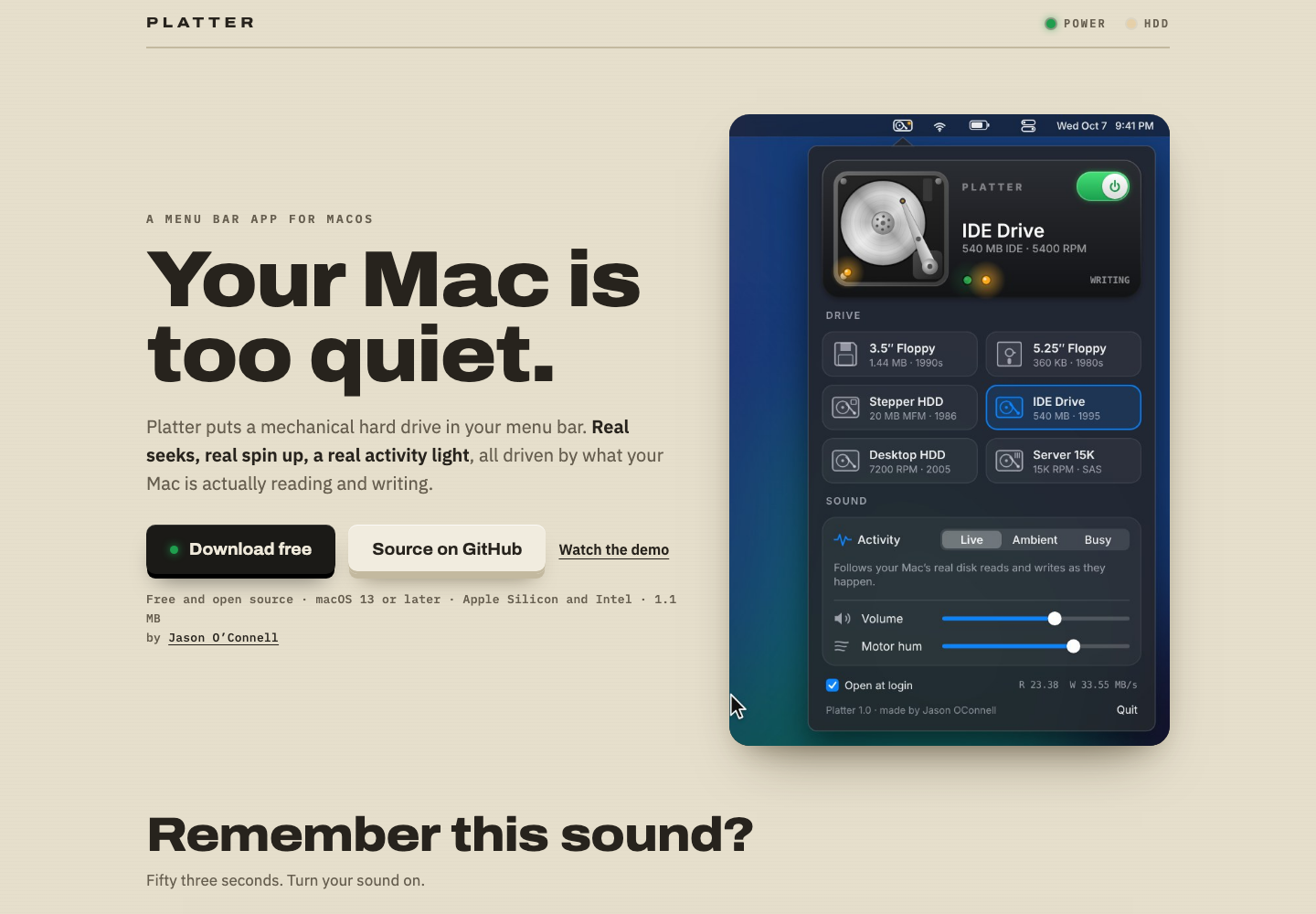
Platter is a particularly clear example of sensory nostalgia. Its project page describes Platter 1.0 as a macOS menu-bar application that synthesizes mechanical-drive sounds (Platter for Mac).
According to that documentation, Platter has three modes:
- Live follows the Mac’s reads and writes.
- Ambient produces intermittent activity framed as an idling older computer.
- Busy presents a heavier workload on a loop.
The page says the sounds are synthesized rather than played from recordings. It also says Live mode reads disk counters and translates activity into audible events (Platter for Mac). These are the creator’s descriptions of intended behavior.
The interesting idea is the reversal at its center. Mechanical storage noise was once an unavoidable byproduct of using a computer. Platter deliberately introduces a version of that noise into a contemporary interface and makes it the point. Live mode associates the premise with current disk activity, while Ambient and Busy provide staged patterns.
Platter’s page also identifies it as free and open source and links to its source code (Platter for Mac). For builders, that makes the project more than a nostalgic concept: its implementation is presented as available for inspection and contribution.
Modem Lab makes dial-up explorable
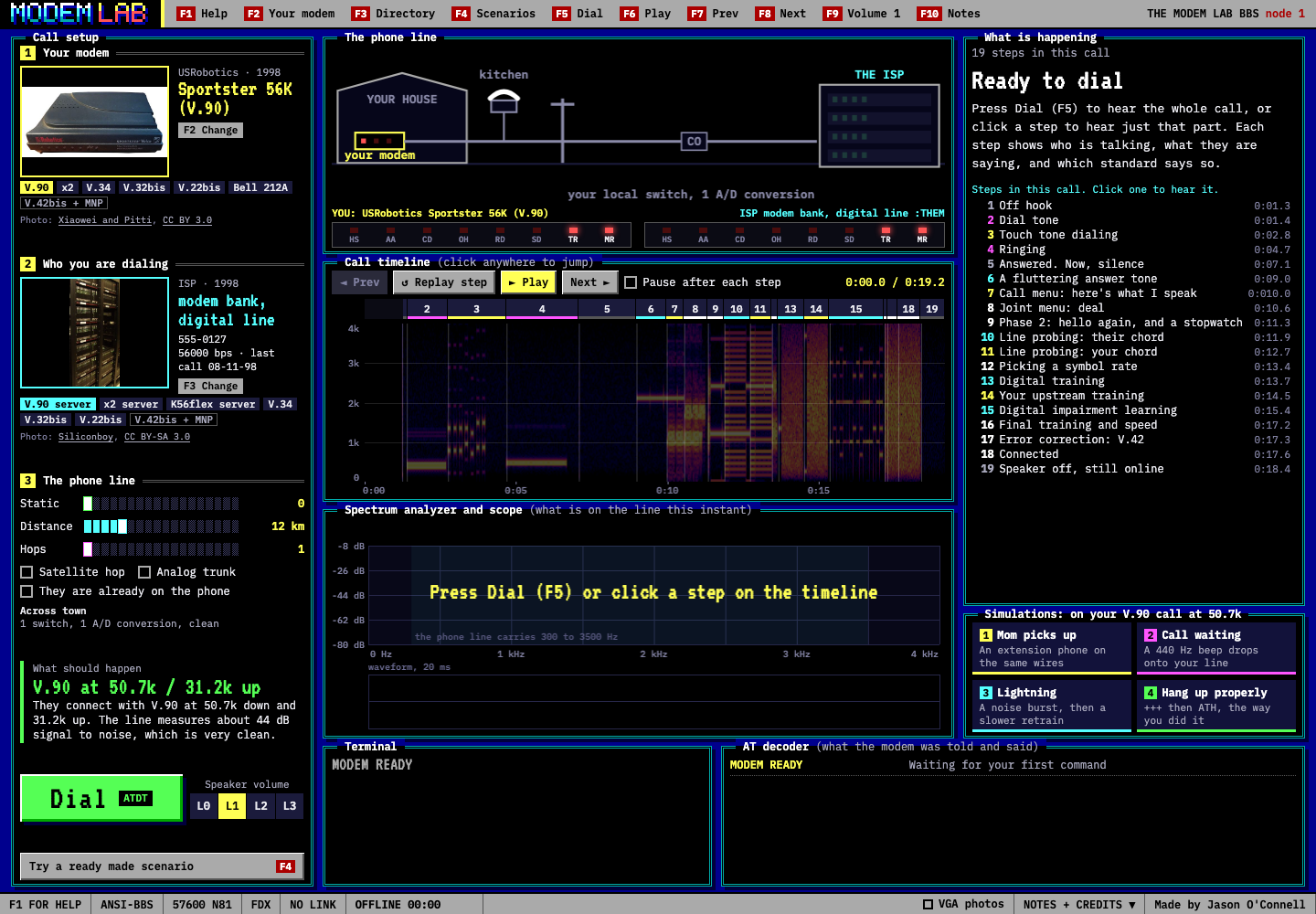
Modem Lab approaches another computing memory through a different interface. Its page displays phone-line controls, playback controls, a navigable call timeline and a terminal decoder (Modem Lab).
It also offers simulated interruptions and events, including someone picking up an extension, call waiting, a noise burst associated with lightning and a hang-up sequence. The timeline can be navigated by jumping to a point or moving between steps, while the decoder displays what the interface says the modem was told and returned (Modem Lab).
The page labels the experience an “Approximation,” so it should be treated as an interactive exploration rather than evidence of physical accuracy or compliance with modem protocols (Modem Lab). Its value here lies in how it organizes the subject. Instead of presenting dial-up as one uninterrupted sound, it separates the displayed call into stages and lets visitors examine its interruptions.
Those scenarios restore the domestic surroundings of the technology. Extension phones and call waiting become selectable elements rather than forgotten annoyances. Like Platter, Modem Lab focuses attention not only on a system but also on the sounds, delays and household conditions that shaped how people experienced it.
A useful method for creative builders
As an editorial reading, Platter and Modem Lab share a focus on specific computing memories. Each begins with a narrow computing memory, selects the human or sensory detail that makes it memorable and turns that detail into an interface.
That offers a practical lesson for small creative projects: start with less than an entire platform or era. Choose one sound, interruption, status signal or ritual that people once learned to interpret. Then build the smallest experience that allows someone to notice and explore it.

No comments yet