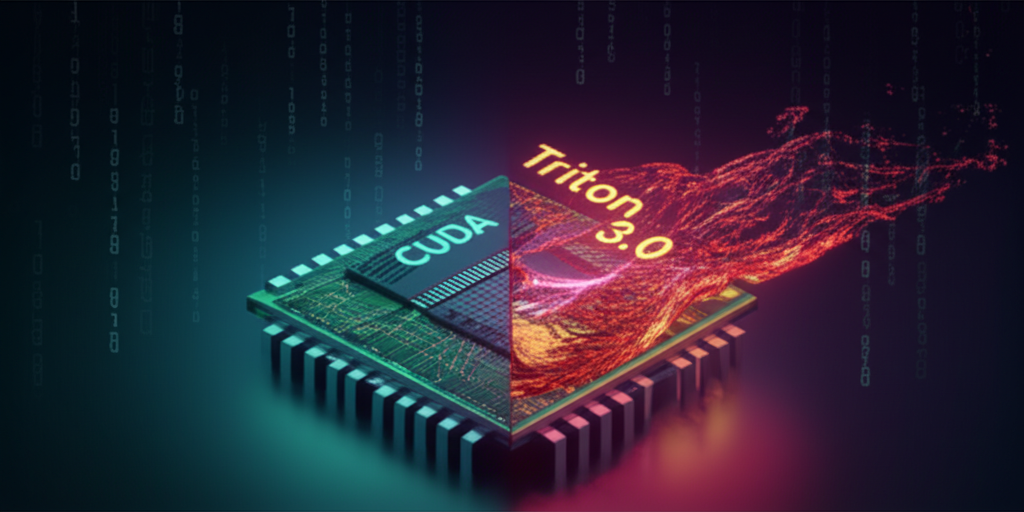
For nearly fifteen years, NVIDIA has ruled the AI landscape not just because of their powerful silicon, but because of an invisible software fortress known as CUDA. This ecosystem created a sticky dependency; once engineers optimized their models for CUDA, leaving NVIDIA meant rewriting the entire software stack. But the tectonic plates of AI infrastructure are shifting. With the release of Triton 3.0 and the impending arrival of the AMD Instinct MI400 series, the industry is finally facing a viable, high-performance path out of the green monopoly.
The 15-Year Monopoly Cracks
To understand why this moment matters, we have to look at the “CUDA Moat.” NVIDIA didn’t just win on raw FLOPS; they won on developer experience. CUDA abstracted the messy details of GPU hardware, allowing scientists and engineers to write C++-style code that ran massively parallel. This created a feedback loop: the best libraries were in CUDA, so everyone bought NVIDIA cards, so everyone wrote CUDA code.
The problem for competitors—primarily AMD—has always been portability. Moving a complex CUDA codebase to AMD’s HIP (or Intel’s SYCL) has historically been a nightmare. It isn’t a simple recompilation. It requires rewriting memory management logic, handling different thread hierarchies, and debugging obscure hardware-specific errors.
This is where Triton enters the chat. Initially developed at OpenAI to replace NVIDIA’s hand-tuned CUDA kernels, Triton operates at a higher level of abstraction. It effectively acts as “Python for GPU.” Instead of managing thread blocks and warps manually, developers write operations on tensor blocks. Crucially, Triton is designed to be hardware-agnostic. It compiles this Python-like logic down to LLVM IR, which can then be targeted at different architectures. With Triton 3.0, the support for AMD’s CDNA architecture has moved from experimental to enterprise-grade, threatening to render the specific underlying GPU (NVIDIA vs. AMD) largely irrelevant to the developer.
Deep Dive into Triton 3.0 Architecture
Triton 3.0 is not merely a maintenance update; it represents a maturation of the compiler technology required to break vendor lock-in. The most significant shift for AMD users is the maturity of the ROCm backend. Previous iterations struggled with complex matrix operations (`tl.dot`) and memory loading patterns on CDNA architectures. Triton 3.0 addresses these head-on.
A standout feature is the introduction of Block Pointers. In traditional CUDA development, one of the most error-prone tasks is calculating global memory indices to ensure coalesced access—where adjacent threads access adjacent memory addresses. If you get this wrong, performance collapses. Block Pointers abstract this entirely. They allow developers to treat multi-dimensional tensors as standard Python objects. The compiler then automatically handles the intricate pointer arithmetic and masking, ensuring that memory accesses on the AMD MI400 are coalesced perfectly without the developer writing a single line of C++.
Furthermore, the new autotuner in Triton 3.0 drastically reduces the kernel development cycle. By automatically testing different parameter configurations (tiling sizes, cache usage), it identifies the optimal settings for the specific hardware. Early benchmarks suggest this reduces kernel development time by approximately 4x compared to writing manual CUDA. Under the hood, Triton 3.0 utilizes Libdevice emulation, mimicking CUDA intrinsic functions to allow code portability. This creates a compilation path that bypasses NVIDIA’s proprietary PTX entirely, flowing from Python source to LLVM IR and finally to AMDGPU ISA.
AMD Instinct MI400: A Hardware Powerhouse
Software is useless without capable hardware, and AMD is positioning the Instinct MI400 as a legitimate contender to the NVIDIA Blackwell/B100 series. Built on the CDNA “Next” architecture and utilizing TSMC’s 3nm node technology, the MI400 represents a radical shift in design.
The MI400 moves to a tile-based design heavily optimized for Float8 (FP8) training. As Large Language Models (LLMs) grow, the precision required for training decreases, making FP8 the sweet spot for throughput. AMD has targeted a 3x to 4x performance-per-watt improvement over the previous MI300 series, largely driven by these Matrix Core optimizations.
Crucially, the MI400 is rumored to support HBM3e or HBM4 memory with bandwidth exceeding 28GB/s per stack. This massive memory bandwidth creates a potential bottleneck for software: can the compiler feed the compute units fast enough? This is where Triton shines. Unlike CUDA, where developers often have to manually manage software-managed caches (shared memory) to hide memory latency, Triton’s abstraction handles software prefetching implicitly. This makes Triton 3.0 an ideal match for the MI400’s massive memory capabilities, potentially allowing it to bypass the “memory wall” that often throttles GPU kernels.
Benchmarking Expectations & Real-World Performance
The true test lies in the numbers. While the MI400 is not yet widely available in the wild, we can project its performance by analyzing the MI300X with Triton 2.0/3.0 backends. In MLCommons tests utilizing Triton on the MI300X, we observed performance parity with NVIDIA’s H100 in specific LLM inference kernels, particularly FlashAttention-2. When utilizing the Triton path, the MI300X achieved roughly 85-90% of the H100’s throughput.
Why wasn’t it 100%? The gap largely stems from how Triton maps to the hardware. NVIDIA’s SIMT (Warp) model and AMD’s Wavefront model handle atomic operations and divergence differently. Triton operates on a “block” level, abstracting this difference, but the underlying hardware architecture still impacts instruction-level parallelism (ILP).
However, the projection for the MI400 is aggressive. With architectural optimizations for sparse matrix math and a compiler that is now mature enough to map `tl.dot` (matrix multiplication) directly to AMD’s Matrix Cores, analysts expect the MI400 to close the remaining gap. We are looking at a potential scenario where Triton on MI400 achieves theoretical TFLOPS utilization comparable to CUDA on Blackwell. If Triton can extract enough ILP to hit the “Roofline” model peak—the limit set by memory bandwidth and compute speed—we could see a near 2x increase in LLM inference tokens per second compared to the previous generation.
The Developer Experience: CUDA vs. Triton
For engineering leads deciding whether to invest in this new stack, the developer experience is paramount. Let’s look at a side-by-side comparison of a simple Vector Add kernel.
CUDA Approach:
// Verbose C++ boilerplate
__global__ void vector_add(float* out, float* a, float* b, int n) {
  int i = blockIdx.x * blockDim.x + threadIdx.x;
  if (i < n) out[i] = a[i] + b[i];
}

// Host code requires explicit cudaMalloc, cudaMemcpy, kernel launch config...
Triton Approach:
@triton.jit
def add_kernel(x_ptr, y_ptr, output_ptr, n_elements, BLOCK_SIZE: tl.constexpr):
    pid = tl.program_id(axis=0)
    block_start = pid * BLOCK_SIZE
    offsets = block_start + tl.arange(0, BLOCK_SIZE)
    mask = offsets < n_elements
    x = tl.load(x_ptr + offsets, mask=mask)
    y = tl.load(y_ptr + offsets, mask=mask)
    output = x + y
    tl.store(output_ptr + offsets, output, mask=mask)
The Triton code is readable, concise, and handles boundary masking (safety checks) natively. There is no `<<
However, the tooling gap remains a concern. NVIDIA's Nsight Systems and Nsight Compute provide deep, granular visibility into pipeline stalls and warp efficiency. Triton's debugging ecosystem, while improving, is not yet as robust as NVIDIA's. For enterprise engineers squeezing out every last ounce of performance, this gap can be frustrating. Yet, the trade-off—hardware agnosticism and 4x faster development—is becoming too compelling to ignore.
Verdict – Is CUDA Dying?
Is CUDA ending? No. CUDA is not going to vanish overnight. It remains the superior choice for low-level graphics programming, physics engines, and legacy systems where absolute hardware control is required. The ecosystem is simply too vast to disappear.
But its monopoly is ending. We are moving toward a dual-stack world. For AI model developers, Triton is rapidly becoming the default. It decouples the software model from the hardware vendor, allowing teams to run on NVIDIA H100s today and AMD MI400s tomorrow with minimal code changes. As Meta has shown by integrating Triton as a first-class backend in PyTorch 2.0, the industry is voting for open interoperability over proprietary lock-in.
For tech leads and infrastructure architects, the message is clear: the moat has been breached. Building internal proficiency in Triton is no longer just an experiment; it is an insurance policy against supply chain constraints and vendor dominance. The future of AI infrastructure is hardware agnostic, and Triton 3.0 is the key that unlocks that future.
Key Takeaways
- Triton 3.0 brings mature AMD ROCm support, specifically optimizing for CDNA architecture with Block Pointers and improved autotuning.
- The AMD MI400 (CDNA 4) combines 3nm process technology with massive HBM bandwidth, targeting FP8 training efficiency.
- Performance parity is within reach: MI300X + Triton achieves ~85-90% of H100 throughput; MI400 is projected to close this gap entirely.
- Triton reduces kernel development time by 4x compared to CUDA by abstracting memory management and thread scheduling.
- The market is shifting from NVIDIA dominance to a dual-stack world where hardware agnosticism is the priority for AI developers.

No comments yet