If you have ever tried to debug an Agentic AI workflow, you know the unique pain of watching a system spin its wheels. Unlike traditional microservices, where a request follows a predictable path from A to B, an LLM agent might call a weather API, fail, decide to calculate the time zone itself, hallucinate a tool name, and finally produce an answer—all while burning through your token budget.
A recent survey by Datadog highlighted that over 60% of organizations adopting AI struggle with significant “observability gaps.” They simply cannot see why an LLM made a specific decision. As we shift from simple chatbots to complex agentic workflows, this lack of visibility becomes a critical bottleneck. Traditional Application Performance Monitoring (APM) tools are ill-equipped for the probabilistic nature of Generative AI.
Fortunately, the industry is coalescing around a solution. The Cloud Native Computing Foundation (CNCF) has prioritized “Observability for AI,” and the OpenTelemetry community has released experimental Semantic Conventions specifically for GenAI. This article explores how to implement these new standards to bring order to the chaos of distributed AI systems.
The Observability Crisis in Agentic AI
To understand why we need new standards, we must first recognize the limitations of our current tooling. In a standard microservices architecture, code is deterministic. If you send a specific payload to an endpoint, you expect a specific result. Debugging is usually a matter of finding the line of code that threw an exception.
Agentic AI turns this paradigm on its head. The system is non-deterministic. The “logic” is often a black-box model running on a remote server. When an agent executes a loop—calling a tool, analyzing the result, and deciding the next step—it introduces a complexity that LangChain’s 2024 report suggests increases debugging difficulty by 10x.
The “Agentic Loop” creates a tracing challenge where context is easily lost. If an agent calls a vector database, then a Python function, and then queries an external LLM, traditional APM tools see these as disparate, unrelated transactions. They lack the semantic understanding to link these steps into a single “thought process.”
Furthermore, the market is currently fragmented. Vendors often offer proprietary SDKs that lock you into their dashboards. This creates a fragmented observability stack where you cannot correlate traces across your vector database (like Pinecone), your LLM provider (like OpenAI), and your custom orchestration logic. This fragmentation is exactly what OpenTelemetry aims to solve.
Decoding the New OpenTelemetry GenAI Semantic Conventions
The core of OpenTelemetry’s power lies in its semantic conventions—a standardized dictionary of names and values that all vendors agree upon. In late 2023 and early 2024, the GenAI Working Group released specifications designed to standardize how we track LLM interactions.
Under these new standards, every span representing an LLM interaction is enriched with specific attributes. For instance, gen_ai.system identifies the model provider (e.g., OpenAI, HuggingFace), which is crucial when your application switches models based on cost or availability.
Reproducibility is another major focus. By utilizing attributes like gen_ai.request.model and gen_ai.response.model, engineers can pinpoint exactly which version of a model was responsible for a specific output. This is vital when a model update unexpectedly shifts behavior.
Perhaps the most important attributes deal with content. gen_ai.prompt and gen_ai.completion allow developers to inspect the inputs and outputs of the model. However, high-cardinality data (like massive prompts) can bloat your tracing backend. Best practices suggest either sampling these attributes or storing them separately, linking them via a hash in the trace.
We also differentiate between two types of spans in this architecture: the LLM span (the actual inference call to the API) and the Workflow span (the orchestration logic managed by frameworks like LangChain or AutoGen). Distinguishing these allows you to isolate whether latency is caused by the model provider or your own routing logic.
Mapping Multi-Agent Workflows to Distributed Traces
When dealing with multi-agent systems, structure is everything. Hierarchical tracing allows us to visualize the “family tree” of an AI decision.
The Hierarchy:
At the top, you have the Root Span: The User Query. This is the parent of everything that follows.
Beneath that, you have Child Spans representing the Agent Orchestrator (e.g., a node in a LangGraph or an AutoGen agent).
Finally, you have Grandchild Spans: the individual tool calls, vector database retrievals, or API requests made by the agent.
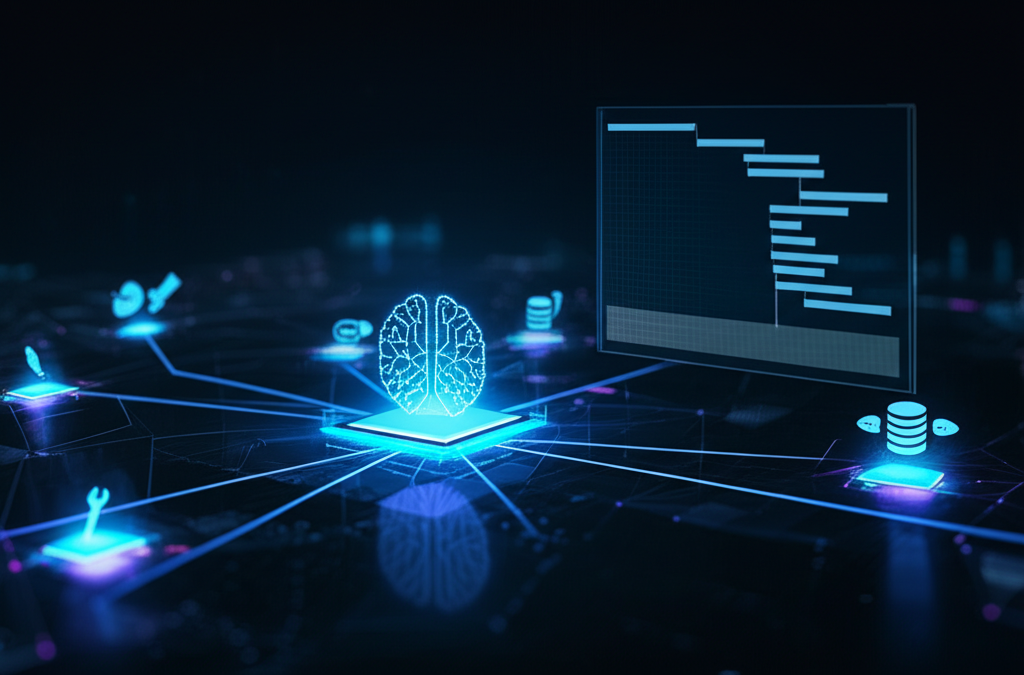
>This structure transforms a confusing log into a clear waterfall view. You can see exactly when the agent decided to branch off into a sub-task, how long that sub-task took, and how it contributed to the final answer.
Context Propagation:
For this to work across different services, we must strictly manage context propagation. The trace_id and span_id must be passed explicitly along every header. If Agent A calls Agent B, which is deployed as a separate microservice, the tracing context must travel in the HTTP headers of that request. Without this strict propagation, the chain breaks, and you are left looking at isolated islands of data rather than a cohesive map of the system’s reasoning.
Instrumenting Function Calling and RAG Pipelines
Two of the most common patterns in modern AI are Retrieval-Augmented Generation (RAG) and function calling. Both have specific instrumentation requirements.
RAG Tracing:
In a RAG pipeline, the retrieval step is often the silent killer of performance. You need to create specific spans for your vector database queries. These should capture latency, but also metadata attributes like db.system (e.g., Pinecone, Milvus) and vector.query.vector. By capturing the similarity scores and the number of documents retrieved, you can correlate retrieval quality with the final generation quality.
Tool Calling Verification:
Function calling is prone to errors where an agent might hallucinate a tool parameter. To catch this, you should tag spans for function calls with a clear tool.name attribute (e.g., get_stock_price). Crucially, you must log the input parameters and the output schema within the span. If an agent attempts to call a weather tool with a string instead of coordinates, the trace will show the mismatch immediately, allowing you to add guardrails to your prompt engineering.
Error Handling:
Standard HTTP errors aren’t enough. OpenTelemetry allows for rich error classification. You should tag spans with specific exception types relevant to AI, such as “Max Tokens Exceeded,” “Safety Filter Triggered,” or “Rate Limit Exceeded.” This granularity allows you to filter traces and find systemic issues, such as a specific prompt template that consistently triggers safety filters.
From Spans to Insights: Analyzing Agent Performance
Once your traces are flowing, the real value begins. Collecting data is useless without extracting actionable insights.
Latency Breakdown:
Distributed traces allow you to dissect the total latency of a request. Is the delay network latency? Is it Time to First Token (TTFT) from the LLM provider? Or is it the agent’s internal “thinking time”? By visualizing the waterfall, you can identify if your agent is spending too much time “reasoning” before acting, which might indicate a need for a more concise system prompt.
Cost Attribution:
“Token bleed” is a silent budget killer. Research indicates unoptimized agent loops can waste 15-30% of token budgets on redundant calls. By summing the gen_ai.usage.completion_tokens and gen_ai.usage.prompt_tokens attributes across every span in a workflow, you can calculate the precise cost of a single user query. This allows you to identify expensive agents or routes and optimize them.
Evaluating Quality:
Finally, traces bridge the gap between system performance and output quality. You can attach “Feedback Scores” (e.g., from an LLM-as-a-judge evaluation) directly as span attributes. This correlation allows you to see, for example, that version 2 of your system prompt produces higher quality answers but with 200ms more latency. This data-driven approach is the holy grail of AI engineering.
Implementation Guide: A Practical Walkthrough
Let’s look at how to actually implement this. While the specifics depend on your language stack, the concepts are universal.
1. Setup and SDK Initialization:
Start by initializing the OpenTelemetry SDK in your application. You will need to configure a resource detector to identify your service and an OTLP (OpenTelemetry Protocol) exporter to send data to your backend (Grafana, Jaeger, or Datadog).
2. Auto-Instrumentation:
The easiest win is using auto-instrumentation libraries. The community has released packages like opentelemetry-instrumentation-openai and opentelemetry-instrumentation-langchain. These automatically wrap your existing calls and emit spans with the correct semantic conventions without you writing a single line of tracing code.
3. Manual Instrumentation for Agents:
For custom logic, you will need manual instrumentation. Here is a simplified Python example showing how to wrap an agent run:
from opentelemetry import trace
tracer = trace.get_tracer(__name__)

def run_agent_logic(user_query):
    with tracer.start_as_current_span("agent.orchestrator") as parent_span:
        parent_span.set_attribute("user.query", user_query)

        # Tool Call Span
        with tracer.start_as_current_span("agent.tool_call", parent=parent_span) as tool_span:
            tool_span.set_attribute("tool.name", "weather_api")
            result = call_weather_api(user_query)
            tool_span.set_attribute("tool.result", result)

        # LLM Generation Span
        with tracer.start_as_current_span("llm.generation", parent=parent_span) as llm_span:
            llm_span.set_attribute("gen_ai.system", "openai")
            llm_span.set_attribute("gen_ai.request.model", "gpt-4")
            response = generate_final_response(result)
            return response
By wrapping your logic this way, you ensure that every step of the agent’s process is captured, correlated, and ready for analysis.
Key Takeaways
- Standardization is critical: OpenTelemetry’s new GenAI semantic conventions provide a unified language to track LLM interactions, moving us away from proprietary “black boxes.”
- Structure your traces: Use hierarchical tracing (Root -> Agent -> Tool) to visualize the “reasoning chain” of your Agentic AI systems.
- Cost and Quality matter: Distributed tracing is the primary method to identify “token bleed” and correlate system performance with output quality through feedback scores.
- Instrument aggressively: Combine auto-instrumentation libraries (for LLM providers) with manual instrumentation (for custom orchestration) to get full visibility.
As Agentic AI continues to evolve, the systems that survive will be the ones we can understand, debug, and trust. Implementing OpenTelemetry today is the first step toward building reliable, production-grade AI agents.
Ready to get started? Check out the official OpenTelemetry GenAI specifications on GitHub and begin instrumenting your first agent workflow.

No comments yet