

In this article
A beta multi-agent response can contain two similar-looking call types with different execution owners:
- OpenAI executes hosted
multi_agent_callcollaboration actions. - Your application executes developer-defined
function_callitems and returns matching outputs.
Those rules apply regardless of which agent produced the item. The item type determines the handling path: applications must not execute multi_agent_call items, but must execute developer-defined function_call items (multi-agent guide).
This article maps that documented boundary across HTTP and WebSocket. It is based on documentation retrieved October 20, 2026; no requests or latency tests were performed.
Enablement and participants
Enable the capability with multi_agent.enabled. Raw HTTP requests and WebSocket connections must also include the beta opt-in header below. For HTTP through the beta SDK, the guide documents passing responses_multi_agent=v1 through the betas argument instead. Item schemas may change while the capability remains in beta (multi-agent guide).
OpenAI-Beta: responses_multi_agent=v1
The documented participants are:
- Root agent: Named
/root. It may create subagents and is responsible for synthesizing their results into the final response. - Subagents: Share the request’s model and available tools.
- Responses API: Runs the agent workflow and executes hosted collaboration actions.
- Application: Executes developer-defined functions and returns their outputs.
- HTTP or WebSocket client: Carries those function outputs back to the API.
Setting multi_agent.enabled makes the root eligible to spawn a tree of subagents. It does not guarantee that subagents will be created or that work will run concurrently (multi-agent guide).
Execution ownership
| Artifact or operation | Origin or role | Execution owner | Application responsibility |
|---|---|---|---|
| Root-agent work | /root processes the request |
Responses API | Receive the resulting output |
| Subagent work | Created through hosted orchestration | Responses API | Do not run the subagent |
multi_agent_call |
Records a hosted collaboration action | Responses API | Do not execute it or submit an output |
multi_agent_call_output |
Result of a hosted action | Already executed by the API | Preserve both items if needed for replay or tracing |
function_call |
May be emitted by any agent | Application | Validate and execute the requested function |
function_call_output |
Result supplied by the application | Application | Return it with the matching call_id |
| Final response | Synthesized by the root agent | Responses API | Consume it as the run’s result |
A multi_agent_call records a hosted collaboration action, such as spawn_agent. The application must not execute the item or send back a result. The Responses API performs the action and returns the corresponding multi_agent_call_output (multi-agent guide).
A function_call crosses the opposite boundary. Any agent in the tree may emit one, but the application must perform the operation and submit a matching function_call_output (multi-agent guide). Responses represents calls and outputs as distinct items correlated through call_id (migration guide).
The response may also contain an agent_message, which the guide defines as an encrypted message carried from one agent to another. It is not a developer-function request. The word “encrypted” should not be extended into security guarantees that the documentation does not make (multi-agent guide).
The bounded sequence
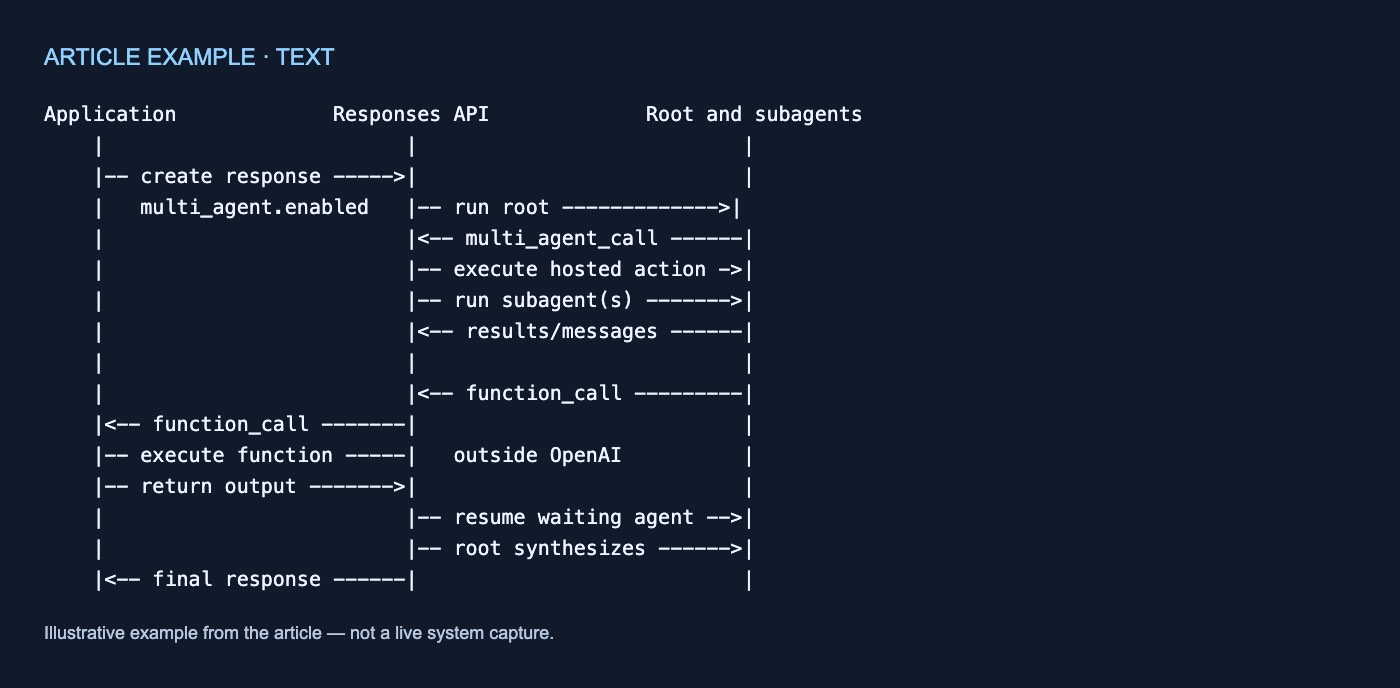
The documented flow can be represented without inferring internal planning or extra lifecycle states:
Application             Responses API             Root and subagents
    |                         |                           |
    |-- create response ----->|                           |
    |   multi_agent.enabled   |-- run root ------------->|
    |                         |<-- multi_agent_call ------|
    |                         |-- execute hosted action ->|
    |                         |-- run subagent(s) ------->|
    |                         |<-- results/messages ------|
    |                         |                           |
    |                         |<-- function_call ---------|
    |<-- function_call -------|                           |
    |-- execute function -----|   outside OpenAI          |
    |-- return output ------->|                           |
    |                         |-- resume waiting agent -->|
    |                         |-- root synthesizes ------>|
    |<-- final response ------|                           |
For example, imagine a subagent requests a developer-defined function that reads a homelab inventory. The API can emit the function_call, but it does not thereby gain or run that application implementation. Your service performs the permitted lookup and returns the result. By contrast, if the response contains a hosted collaboration action used to coordinate agents, your service observes rather than executes it.
HTTP: continue with a new request
Over HTTP, the response completes once every active agent has either finished or paused while waiting for a client-executed function. The application then executes all outstanding function calls and submits their outputs in a new Responses API request, allowing paused agents to resume (multi-agent guide).
The application-side sequence is:
- Collect outstanding
function_callitems. - Validate the function names and arguments.
- Execute the permitted application functions.
- Create matching
function_call_outputitems using the correctcall_id. - Submit those outputs in a continuation request.
A single multi-agent run may therefore span multiple Responses API requests, although the documentation does not say that every run will do so (multi-agent guide).
WebSocket: inject into the active response
WebSocket preserves the same ownership boundary but changes the return path:
Agent -> function_call
Responses API -> WebSocket client
Application -> execute function
Application -> response.inject(function_call_output)
Responses API -> resume waiting agent
Root agent -> final response
The application sends each result to the active response with a response.inject event. The waiting agent can resume without waiting for the complete multi-agent response to finish (multi-agent guide).
HTTP and WebSocket expose the same documented multi-agent capabilities. OpenAI recommends WebSocket for tool-heavy or long-running workflows because its persistent connection can reduce continuation overhead. That is documentation guidance, not a measured or guaranteed advantage for a particular workload (multi-agent guide).
Separate API concerns
Authentication and request IDs
Responses requests use HTTP Bearer authentication with an API key or short-lived workload-identity token. API keys should not be exposed in browser or application client-side code (API overview).
The API returns an x-request-id for troubleshooting. Callers may also explicitly supply a unique X-Client-Request-Id; it is not added automatically (API overview). These identifiers trace API requests, not individual agents, and do not change function ownership.
Background mode
Setting background: true starts asynchronous response processing that an application can poll (background mode guide). Multi-agent mode has its own enablement field, multi_agent.enabled. The supplied documentation treats these as separate options and does not identify background mode as a multi-agent prerequisite.
Current beta constraints
With multi-agent mode enabled, /responses/compact, reasoning.summary, and max_tool_calls are unsupported. Automatic server-side compaction is implicitly enabled, even without an explicit context_management configuration. These constraints—and the item schemas—may change during the beta (multi-agent guide).
The integration decision ultimately follows the item: observe hosted collaboration items, but dispatch developer-defined function calls to application code. Return those results through an HTTP continuation request or, for an active WebSocket response, through response.inject.
No comments yet