The race for longer context windows in Large Language Models (LLMs) has been one of the most defining trends of the last year. We moved from 2k contexts to 100k, and now whispers of 1M+ token windows are becoming reality. But for systems architects and ML engineers, simply increasing the context window isn’t just a parameter change—it’s a brutal confrontation with the laws of physics and hardware limitations.
Standard Transformer architecture hits a memory wall that makes long context incredibly expensive. To push beyond this, researchers have moved away from simple approximation tricks and toward fundamental systems redesign. The leading solution emerging from UC Berkeley—Ring Attention—offers a path to near-infinite context by distributing the sequence across devices. Here is how it works and how to implement it.
The “Memory Wall” of Modern Transformers
To understand why Ring Attention is necessary, we have to revisit the fundamental bottleneck of the Transformer architecture: the self-attention mechanism.
In a standard Transformer, the attention mechanism computes an $N imes N$ matrix where $N$ is the sequence length. This results in $O(N^2)$ time complexity and quadratic memory growth for the Key-Value (KV) cache. As the sequence length doubles, the memory requirement quadruples. This makes scaling to massive context lengths mathematically possible but economically and technically prohibitive on a single device.
Consider the VRAM math for a popular model like Llama-2-7B. To handle a 4k context window, the model requires roughly 1.6GB of VRAM just for the KV cache. If you try to scale that to a 1 million token context on a single A100 (80GB) or H100, the math simply doesn’t work. You would need hundreds of gigabytes of HBM just to store the cache, not to mention the model weights and gradients required for training.
Historically, engineers have turned to approximation techniques to bypass this. Sliding window attention, for instance, only lets the model attend to recent tokens, ignoring distant history. Linear attention approximates the softmax calculation to reduce complexity. While these methods save memory, they come at a steep cost: loss of precision and degraded recall performance. If a model “forgets” data placed 50k tokens ago, it is useless for analyzing entire codebases or legal archives.
The goal for the next generation of AI is not just *long* context, but *lossless* long context. We need the full $O(N^2)$ attention capability without the single-device memory constraint.
Architecture of Ring Attention
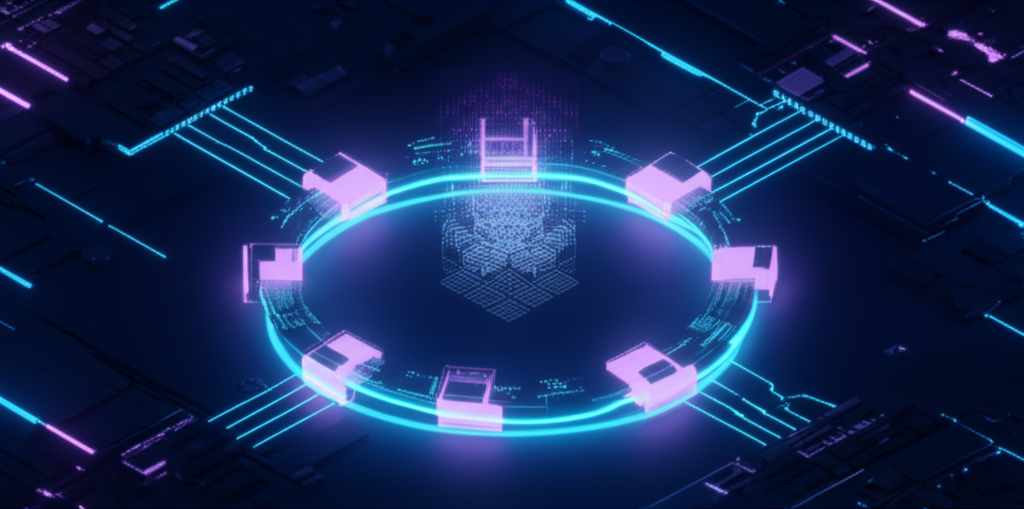
Ring Attention, introduced by researchers at UC Berkeley (Hao Liu et al.), solves this by treating the GPU cluster as a single, cohesive memory bank rather than isolated islands. It introduces a form of Sequence Parallelism that distributes long sequences across multiple GPUs in a logical ring topology.
Imagine your GPUs arranged in a circle. Device 0 connects to Device 1, which connects to Device 2, and so on, until the last device loops back to Device 0.
In this setup, the input sequence is chunked into blocks. Device 0 holds Block 0, Device 1 holds Block 1, etc. The core innovation of Ring Attention is the strategy of Compute-Communication Overlap.
Instead of gathering the entire sequence onto one GPU to compute attention (which would cause an OOM error), the devices compute attention on their local blocks while simultaneously passing KV blocks to their neighbors. While Device 1 is calculating attention scores for its local data using the Keys and Values it currently holds, it is simultaneously receiving the previous block’s KV data from Device 0 and sending its own KV data to Device 2.
This overlap effectively hides the communication latency behind the computation time. Mathematically, this reduces the memory complexity per device from $O(N)$ to $O(N/K)$, where $K$ is the number of GPUs. By adding more GPUs, you can linearly scale the context window size without hitting the memory limit of a single card.
Deep Dive — Implementation Mechanics
Implementing Ring Attention requires a shift in how we handle the forward and backward passes. The system relies on Blockwise Transformers, where the sequence is treated as a stream of state passing around the ring.
The Forward Pass Logic
The attention equation is $\text{Attention}(Q, K, V) = \text{softmax}(\frac{QK^T}{\sqrt{d_k}})V$. In a distributed setting, we want the Output $O_i$ for a block to be the sum of attention scores across all blocks $j$: $O_i = \sum_j \text{softmax}(Q_i K_j^T) V_j$.
Ring Attention computes this incrementally:
- Load Local Block: Each device loads its local Query ($Q$), Key ($K$), and Value ($V$) embeddings.
- Compute Local Attention: The device computes the attention score between its local $Q$ and the $K, V$ currently in its memory (which starts as its own).
- Update State: The output attention matrix is updated incrementally. A crucial technical detail here is maintaining the softmax statistics (max and sum values) to normalize the scores correctly as new blocks arrive.
- Communicate: The device sends its local $K, V$ blocks to the right neighbor (ring send) and receives $K, V$ blocks from the left neighbor (ring receive). This uses non-blocking communication primitives.
- Repeat: Steps 2-4 repeat until every block has visited every device. At this point, each device holds the complete attention output for its specific chunk of the sequence.
Backward Pass & Gradients
The backward pass is essentially the reverse of the forward pass. Gradients flow backward through the ring in the opposite direction. Because the computation is deterministic and the ordering of blocks is consistent, gradients synchronize naturally. The system ensures that the gradient for the KV cache on a specific device aggregates contributions from all Queries across the ring before updating the model weights.
Engineering the Stack (Code & Config)
Ring Attention is distinct from other parallelism strategies. You likely already use Tensor Parallelism (TP) to split a model layer across multiple GPUs or Pipeline Parallelism (PP) to split layers across stages. Ring Attention is Sequence Parallelism. It can be combined with TP and PP, but it requires careful configuration.
To implement this, you generally utilize a framework that supports sophisticated communication schedules. The technique originated in **JAX** due to the ease of `pmap` and `pjit` for managing distributed arrays, but it is rapidly making its way into **PyTorch** via custom kernels and `torch.distributed`.
Communication Primitives
The efficiency of Ring Attention hinges on non-blocking collectives. You must use NCCL (NVIDIA Collective Communications Library) calls that allow the GPU kernel to continue computing while the data bus is moving data. Specifically, you are looking at `send`/`recv` pairs or optimized `all-to-all` implementations that utilize the NVLink bandwidth.
If your interconnect is slow (e.g., standard Ethernet or InfiniBand without NVLink), the “compute” phase will finish faster than the “communication” phase, creating a “bubble” of idle time where GPUs wait for data. This is why Ring Attention shines best on NVIDIA H100 clusters connected by NVLink, where the bandwidth is exceptionally high (900GB/s+).
Pseudo-Configuration
In a typical setup, your configuration might look like this:
- Global Batch Size: Determined by the total sequence length.
- Ring Size: Number of GPUs participating in the sequence dimension.
- Block Size: The chunk size (e.g., 4k or 8k tokens) sent per step.
When initializing the model, you must ensure the Key and Value caches are not allocated on a single device but are sharded across the device group from the start.
Benchmarks, Recall, and Use Cases
Does this actually work in practice? The data suggests yes. The original Ring Attention paper demonstrated training on sequences up to 100 million tokens using 256 H100 GPUs. For inference, benchmarks show sustained throughput at 1M+ tokens with negligible overhead compared to standard attention on shorter sequences.
Needle in a Haystack
The standard “Needle in a Haystack” benchmark is the ultimate stress test for context windows. It involves inserting a specific fact (a needle) into a long document (the haystack) and asking the model to retrieve it.
Approximation models (like those using sliding windows) tend to fail past 32k or 128k tokens because the needle falls out of the window. Ring Attention models, however, maintain 100% retrieval success even at 1M tokens because they are mathematically equivalent to full attention—just distributed. The model truly “sees” the entire history.
Real-World Applications
Opening the 1M token door unlocks use cases that were previously impossible:
- Codebase Analysis: Feed an entire monorepo (millions of lines of code) into the context to ask architectural questions, find bugs, or generate documentation that spans multiple files.
- Legal & Financial Discovery: Ingest entire case law libraries or financial histories in a single prompt without chunking or RAG pre-processing.
- Long-Context Video Understanding: Processing video frames as a token sequence. A 1M token window can allow a model to watch and analyze over an hour of high-definition video content in a single pass.
The Future of Context Windows
Ring Attention effectively solves the memory problem, but it introduces a new challenge: latency. While memory scales linearly with the number of GPUs, the time to generate a token does not. Generating a single token in a 1M context still requires the model to attend to 1M tokens worth of history.
This creates a decoding bottleneck. Reading 1M tokens from distributed HBM takes time, even with NVLink. Therefore, while “infinite” context is possible for ingestion, the speed of inference (Time to First Token and generation speed) decreases as context grows.
The future likely lies in hybrid approaches: using Ring Attention for “hot” context that requires deep reasoning, combined with Retrieval-Augmented Generation (RAG) or traditional caching for colder data. However, Ring Attention remains a paradigm shift. It proves that we do not need to approximate the Transformer architecture to achieve massive scale. By rethinking the system topology, we can utilize the full power of existing models without sacrificing their intelligence or recall precision.
Key Takeaways
- Quadratic Bottleneck: Standard attention requires $O(N^2)$ memory, making 1M token context impossible on single GPUs due to KV cache limits.
- Ring Topology: Ring Attention distributes sequences across GPUs in a ring, overlapping communication with computation to hide latency.
- Lossless Scaling: Unlike sliding window or ALiBi, Ring Attention maintains 100% recall precision ( Needle in a Haystack) by computing full attention.
- Hardware Dependency: Performance relies heavily on high-bandwidth interconnects like NVLink to minimize the “bubble” between compute cycles.
- Infinite Potential: The context window is now bounded only by cluster size, not architecture, opening doors for analyzing entire codebases and video histories.
Are you currently tackling the context limit in your LLM applications? Share your experiences with distributed inference in the comments below or join the discussion on the RodyTech Discord.
No comments yet